





Key Takeaways:
Roz Samimi was 16 years old when she got her first look inside the beauty industry. It wasn’t through a textbook, a program, or a school lesson, but rather a high school romance. The son of Lilli Gordon, founder and former CEO of First Aid Beauty, was her first love, and as a result, Gordon invited the high school junior to intern for her that summer. While sitting in on a product development session for an oil-to-milk cleanser and listening to the team dissect formula and texture, something clicked. “[It was always the] product that made me excited about beauty,” Samimi said. Even after the relationship with Gordon’s son ended, Samimi made sure to stay in touch with Gordon, who eventually became her mentor.
Gordon, for her part, saw something in Samimi early on that went far beyond the circumstances of how they met. “I don’t think she was ever really 16 in her life, except biologically,” Gordon told BeautyMatter. “She was always very mature.”
What Gordon saw in Samimi wasn’t just maturity, it was ambition, intellect, curiosity, and a quality of thinking she describes as rare. “[Samimi] is really smart, and I don’t take that lightly. She thinks [outside of the box], and she loves the world of beauty,” she said, adding, “She wasn’t this 16-year-old sitting in the conference room. She always felt quite comfortable sharing her views.”
Fast-forward a decade: that spark led to the creation of Banu Skin. The acne-safe prestige skincare brand was selected to participate in the Sephora Accelerate Program in 2024 and officially launched on Sephora.com and via its own DTC site a year later. During that process, Gordon transitioned to an advisory role and now holds a board seat and serves as the brand’s lead investor.
The path from mentor to investor wasn’t linear. The inflection point, Gordon recalled, came when Samimi pitched her formally in her living room.
“She walked me through the deck. The deck was excellent. Did it need work? Did it need refining? For sure. But was there something there … a vision and a point of difference,” she said.
Gordon shared the two things that sealed it for her: the power of Samimi’s personal story, and the clarity of the white space she was targeting.
“When she pulled up pictures of her skin, I thought, ‘Wow.’ She was living it, and knew the need.” From that moment, Gordon said, her decision was made. “I was in, and I knew I could get people I know behind this brand.”
It’s worth noting that Gordon came in not just with capital, but with a network of investors, too. Her prior investors from First Aid Beauty became part of Banu Skin’s early raise—a tight round followed by a second. (Gordon declined to share the exact figure, but she did say that it was “three to four times” the amount she needed to launch her own brand.)
“We came up with a core group that included her family, myself, and a few people who invested in First Aid Beauty,” Gordon said. She also leaned into her operational experience to close a potentially detrimental financial gap. “[Samimi] doesn’t have a background in finance,” said Gordon, which is why she tapped the former CFO from First Aid Beauty to come on board in a consultant role to help build out Banu Skin’s financial infrastructure. "I was insistent on her hiring him because I knew those systems—I relied on them for 10 years."
Gordon also notes that her contribution extends beyond her financial stake. “I also got some sweat equity—full transparency—because I’ve spent a lot of time way beyond my financial investment,” she said.
When asked what it takes to back a founder without a built-in following, Gordon was candid. She attributed the majority of the fundraised resources largely to content creation and social advertising. “[Samimi] is not an influencer, she's not an actor—she's just a person. She’s got a big, steep hill to climb.”
It’s a reality that points to a broader structural gap Gordon says she finds telling. “I’m actually surprised that there’s not … a group of female [beauty] founders who’ve come together to back the next generation. A lot of us do it individually, but nobody’s put it together as a group,” Gordon said.
But that's also what makes her investment feel personal. “As an investor, we want to create value. As a mentor, I want to show the way that she can create value.” A dual role, she says, creates alignment, not conflict. “They're very consistent.”
At the core of it all, Gordon says that beyond strategy and capital, what makes their relationship successful is actually quite simple. “This is the most serious relationship I've had with a mentee,” Gordon said, but what makes their dynamic work comes down to two things: “Trust and respect. That's it.”
That investment—in time, capital, and network—appears to be paying off. Nine months in, Samimi predicts Banu Skin will generate $1-$3 million in retail revenue in its first full year—a focused start for a founder playing a long and strategic game.
The Gap Banu Skin Wants to Claim
According to Samimi, the idea for Banu Skin didn’t come from a market study. It came from Samimi’s own 15-year battle with acne as she cycled through dermatologists, aestheticians, and a naturopathic doctor. It wasn’t until she dug deeper into the ingredients of the products available on the market at that time that she noticed a recurring problem: pore-clogging ingredients in nearly everything she was using.
“Safe for sensitive skin was part of the vernacular, but [safe for] acne-prone skin wasn’t,” she said.
As a result, she first wrote what she now calls a two-page manifesto in January 2021 and, in October of that same year, she launched a blog called Banuskin.com (now the brand’s DTC site) where she vetted existing products formulated without pore-clogging ingredients but that weren’t marketed as acne-safe. Samimi recalled how hard that database was to build and how that difficulty eventually helped her identify the white space in the market—and the foundation for her business. Taking a cue from Gordon, a pioneer in the “safe for sensitive skin” category, Samimi is making the same move for acne-prone skin.
“[Gordon] pressed me a lot on clarity,” said Samimi. “That’s why I did years of research before I launched the brand to help me clarify what this brand is and is not. Being ultra clear and simplifying what this brand is has been a game changer.”
“At the beginning, it was really about honing in on the concept and the demographic,” Gordon said. “A lot of people who were founders, their brand ideas are too grandiose. Sometimes, the best ideas are laser focused.”
The Key Differentiator
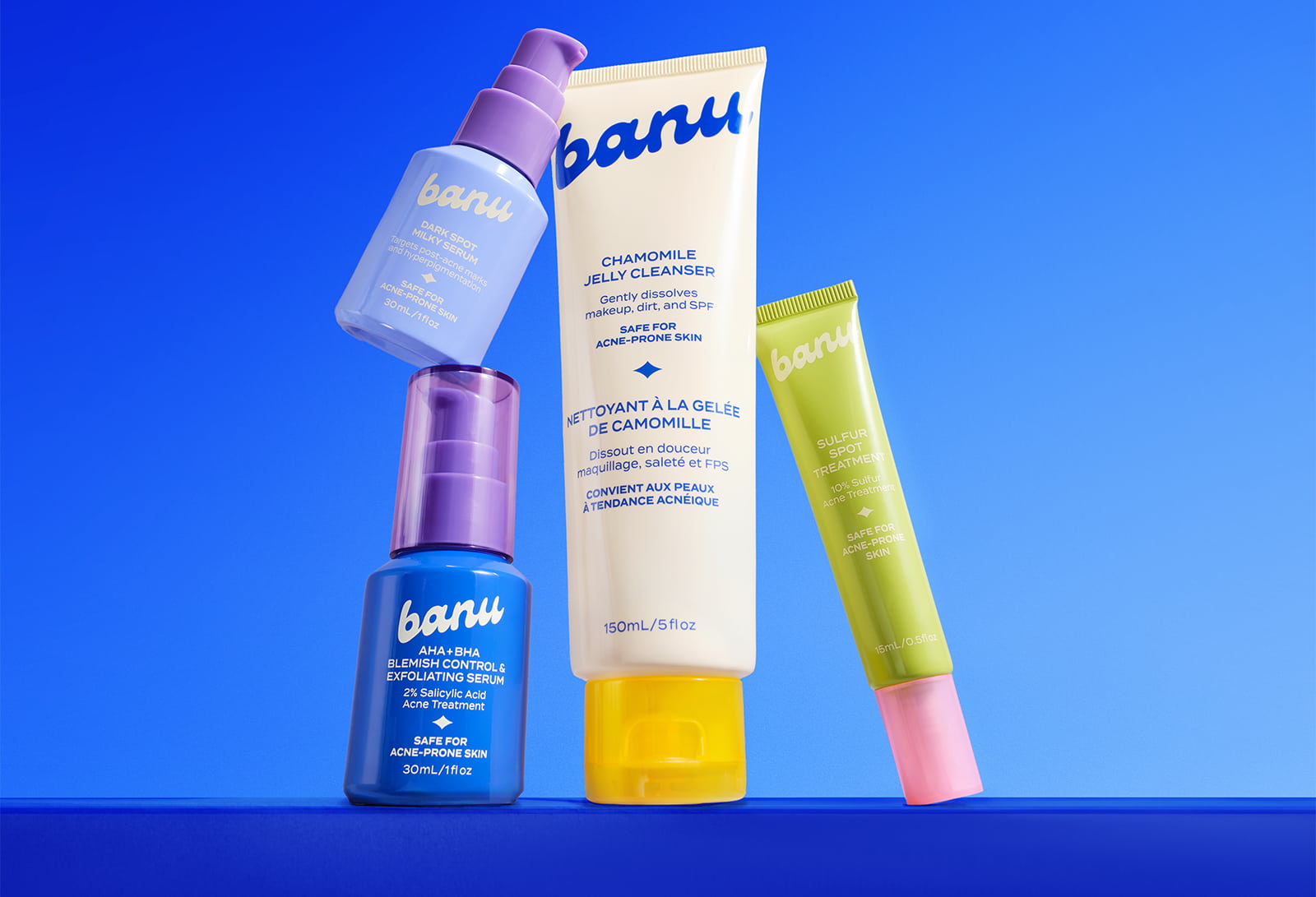
Banu Skin launched with three SKUs: a $30 Chamomile Jelly Cleanser, a $30 Sulfur Spot Treatment, and a $50 AHA x BHA Blemish Control and Exfoliating Serum. In February, the brand added its fourth product: the $54 Dark Spot Milky Serum, a lightweight daily treatment formulated with 3% tranexamic acid, 2% alpha arbutin, and 2% niacinamide, all working together to visibly fade hyperpigmentation and post-acne marks without irritation and pore congestion, according to the company.
The positioning is intentional—rather than framing it around hyperpigmentation broadly, Banu Skin speaks to it specifically in the context of active acne and its aftermath.
As part of Samimi’s efforts to position Banu Skin’s authority, every single product the brand produces must pass Banu Skin’s non-acnegenic testing protocol: formulated without potential pore-cloggers, then clinically tested with acne-prone participants across various Fitzpatrick skin types who use it as intended on the face for at least 30 days, measuring changes in pustules, papules, and comedones from baseline to the end of the testing cycle.
It was a standard Samimi constructed herself. “There isn’t an agreed-upon ‘this is the list of pore-clogging ingredients’ set in the industry yet, so I created my own,” she said.
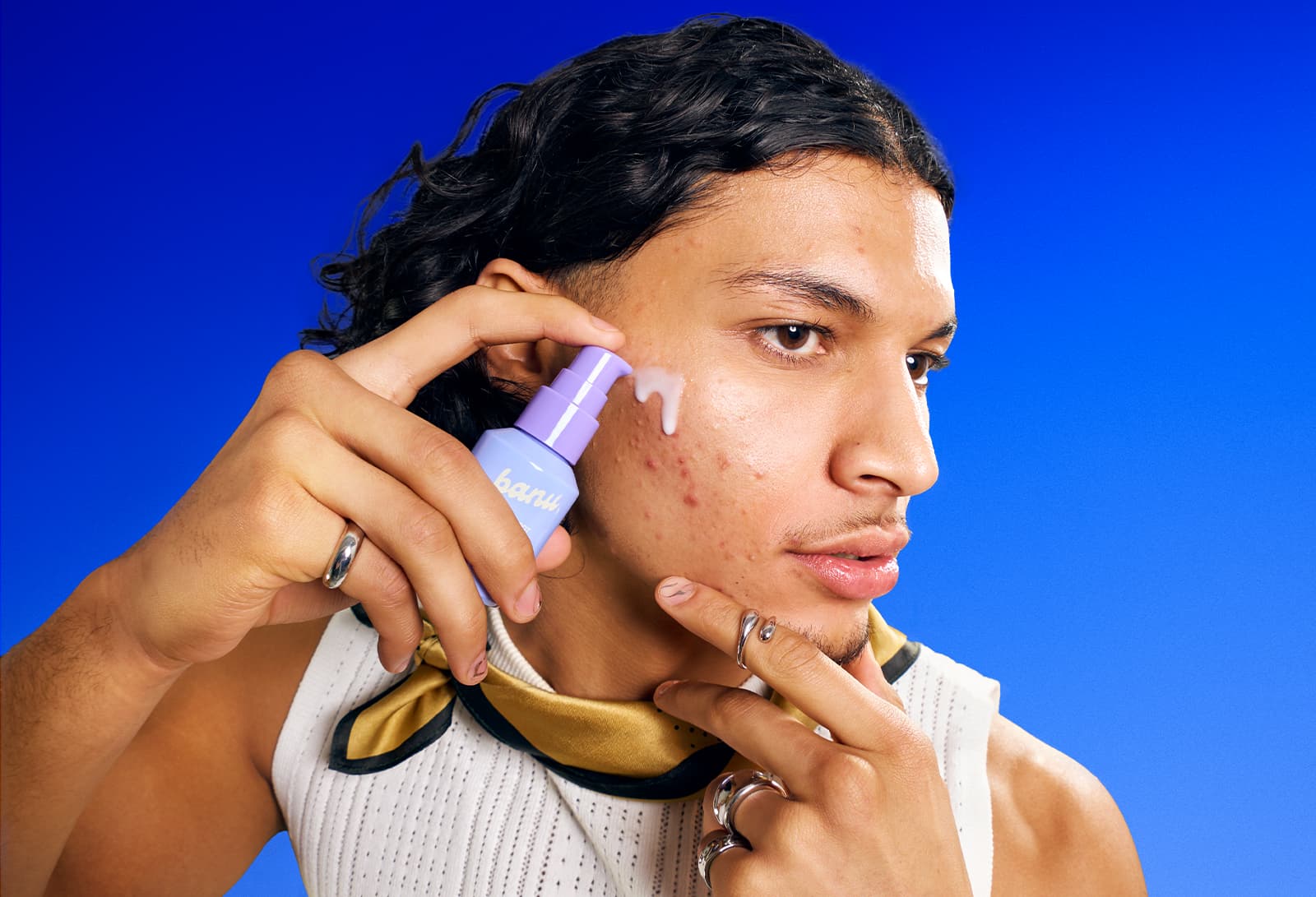
And when it came to the packaging, Samimi emphasized the necessity to create a brand identity that was the opposite of everything acne care has historically looked and felt like. Drawing on her Iranian heritage, Samimi built a mood board that pushed back against what she called the “clinical beige” within the category.
She added that advisors warned her a colorful Sephora end cap could read as immature, but she pushed back. “Why does color signal immaturity and not authority?” As a result, she landed on royal blue as Banu Skin’s signature hue, with glass components for a sustainability edge and tactile prestige, and thick cream unit cartons with embossed detailing.
Gordon's fingerprints are visible within the creative process, too. But when it came to actual packaging decisions, Gordon explained that it was important that she took a back seat and instead empowered Samimi to make the final call. “Of course there are things I would have done differently, quite frankly, but it was [Samimi’s] vision. I couldn't interfere.”
Distribution, Growth, and What’s Next
Banu Skin is currently sold online at Sephora and through its own DTC channel, but additional retail conversations are underway, though Samimi is deliberate about timing. The brand has already begun regulatory preparation for Canada, given the extended compliance process for its two OTC SKUs. International expansion beyond that is not in the near-term plans for now. “I want to go deep with the market we have and the opportunity in front of us.… I'm not in a rush to expand,” she said. “I also want to make sure that we have a community ready and [that] is asking for us.”
Early data is encouraging. Customer analysis places Banu Skin’s core buyer at ages 25 to 44—the adult acne consumer Samimi always designed for, despite early pressure to skew younger. Samimi told BeautyMatter that the Sulfur Spot Treatment, the brand’s hero SKU, currently leads on replenishment; she also noted that customers are buying multiple bottles of the Exfoliating Serum at once, using it daily as a preventative. She added that subscriptions are coming later this year, but she is still refining the program’s structure and pricing.
As Samimi thinks about the future of Banu Skin as it approaches its first anniversary, she says that the next chapter is about community as much as commerce. Which means more IRL events, in-person moments, and building the kind of brand people are proud to use, not just relieved to find.
“There [aren’t many] acne brand’s universe that you really want to be part of,” Samimi said. While newer entrants like Starface and Topicals have begun carving out that kind of identity in recent years, the space remains largely wide open. “There are brands that represent something more than their product. If I have this product, it represents a community that I’m a part of and the values that I hold. That has not been done [as much] in the acne world.”
It’s the same instinct Gordon had when she set out to own sensitive skin in prestige beauty, before the industry knew it needed a name for it. Samimi watched that happen from a seat at the table when she was 16. Now, she’s building a new table for herself.