





The ability of artificial intelligence to make more precise foundation shade recommendations hinges on a debate about a much older form of technology that dates back to the 19th century: the camera.
Estée Lauder, e.l.f. Beauty, Mary Kay, and Clarins have taken a wide array of approaches to AI-based foundation and concealer discovery. As the fastest-growing facial makeup category, foundation and concealer is projected to generate $20 billion in global sales by 2027, according to research firm Euromonitor. Increasingly, these AI tools have been deployed across mobile apps, desktop websites, and in-store experiences, with a goal of better determining a customer’s complexion and undertones and making more accurate product recommendations.
Experts say when implemented properly, AI-enabled shade finders can make more inclusive, personalized recommendations and help brands upsell other beauty products like lipstick or eyeshadow. The apps and the underlying data they are trained on can also take into account regional or trend preferences; a Caucasian consumer in the United Kingdom, for example, may want shades that are a bit more bronze, whereas in France, preferences tend to skew paler.
There are still challenges to overcome, like how technologists use their software and AI algorithms to ingest the data. Insights gathered must then be tailored to each brand’s unique product portfolio. Plus, the many variations for how makeup is applied across different skin tones are another consideration. Shoppers need to be convinced that these AI-enabled tools can be trusted. But the smartphone’s camera technology is where experts don’t see eye to eye.
“The challenge with cameras, and photography in general, is that they’re not a reliable source of information about color,” Konrad Jarausch, CEO of Silicon Valley startup IlluminateAI, told BeautyMatter.
“Cameras, unfortunately—even with how amazing they are now—they still don’t do a good job of really being able to take a high-quality capture for shade matching,” said Rachel Wilson, co-founder and CEO of beauty tech startup BoldHue, in an interview with BeautyMatter.
Meanwhile, Wayne Liu, Chief Growth Officer and President of Americas for AI and augmented reality company Perfect Corp., sees things differently. “We are really good at digital signal processing,” Liu told BeautyMatter, in reference to a smartphone’s ability to capture facial color data for the company’s predictive AI algorithms.
IlluminateAI’s technology captures a series of selfies, modulating the light from the smartphone screen. The company’s software then subtracts the effects of ambient room light and measures how much light from the phone screen reflects off the face.
“AI is dependent on data,” said Jarausch, who co-founded IlluminateAI in 2021. “If you don't have good input data, then AI is very limited. And that's one of the challenges in the beauty space today. That’s really the area we are focused on.”
In August, e.l.f. Beauty announced it had integrated IlluminateAI’s shade finder tech into its app and, since then, has seen a 3x increase in conversion compared to other ecommerce tools. It also increased the likelihood that a customer would add an item to their online cart more than 50% of the time. “Both of those numbers have held steady over the last nine months,” Jarausch said.
More recently, IlluminateAI is the tech that enables Clarins’ AI Shade Finder, an entirely in-store experience, piloted at the skincare and cosmetics company’s boutiques in France and the United Kingdom. The Shade Finder provides results in less than 60 seconds, has a 96% match rate compared to a professional makeup artist, and has doubled basket sizes at shops where the new tech is available, according to Clarins.
“Physical retail was the right environment to launch, test, and refine the experience under real conditions, while ensuring the highest level of reliability,” Laurent Malaveille, Chief Digital, IT & Business Support Officer at Clarins, told BeautyMatter. “Shade matching requires precision in lighting, so starting in-store allowed us to control the experience and learn directly from beauty coaches and consumers.”
Malaveille said Shade Finder’s deployment has given beauty coaches a more concrete and objective starting point to discuss complexion, undertone, and makeup needs with customers. “The future is not in-store versus online, but a seamless online experience where consumers can access the same trusted Clarins expertise where they choose to shop,” said Malaveille.
Another player in the space is FitSkin, which was founded ten years ago and performs skin imaging analysis for retailers, including Sephora and Walgreens Boots Alliance. Their customers can have their faces scanned in under a minute by FitSkin’s SkinScanner technology, which relies on analysis captured from an iPhone with a hardware attachment. FitSkin completes over 40 million scans per year.
CEO Sergio Rattner tells BeautyMatter that iPhones and other cameras don’t accurately capture dark skin tones. “It’s a big problem, especially if you are a retailer like Sephora, where they have 5,000 SKUs for foundation, and the difference between SKUs can be so subtle,” said Rattner. At Sephora, he said FitSkin has doubled the average basket size when its technology is used by the retailer’s employees.
FitSkin’s SkinScanner scans the skin and magnifies and measures moisture, pores, and fine lines. It also uses a dedicated light source, via LEDs, while blocking ambient light from being applied to the skin directly. Scans are intended to be completed in less than a minute. “The magnification is useful for skin analysis, the dedicated lighting is useful for color analysis,” added Rattner.
BoldHue’s Wilson said her initial interest in entering the foundation industry stemmed from dissatisfaction with the products she found on the shelf. Being half Argentinian, she said, “I really have always struggled to match foundation. I either look like a ghost or a pumpkin.” Getting the right shade match is also critical for every other cascading beauty decision around lipstick, eyeshadow, and blush. “If your canvas is off, everything is off,” said Wilson.
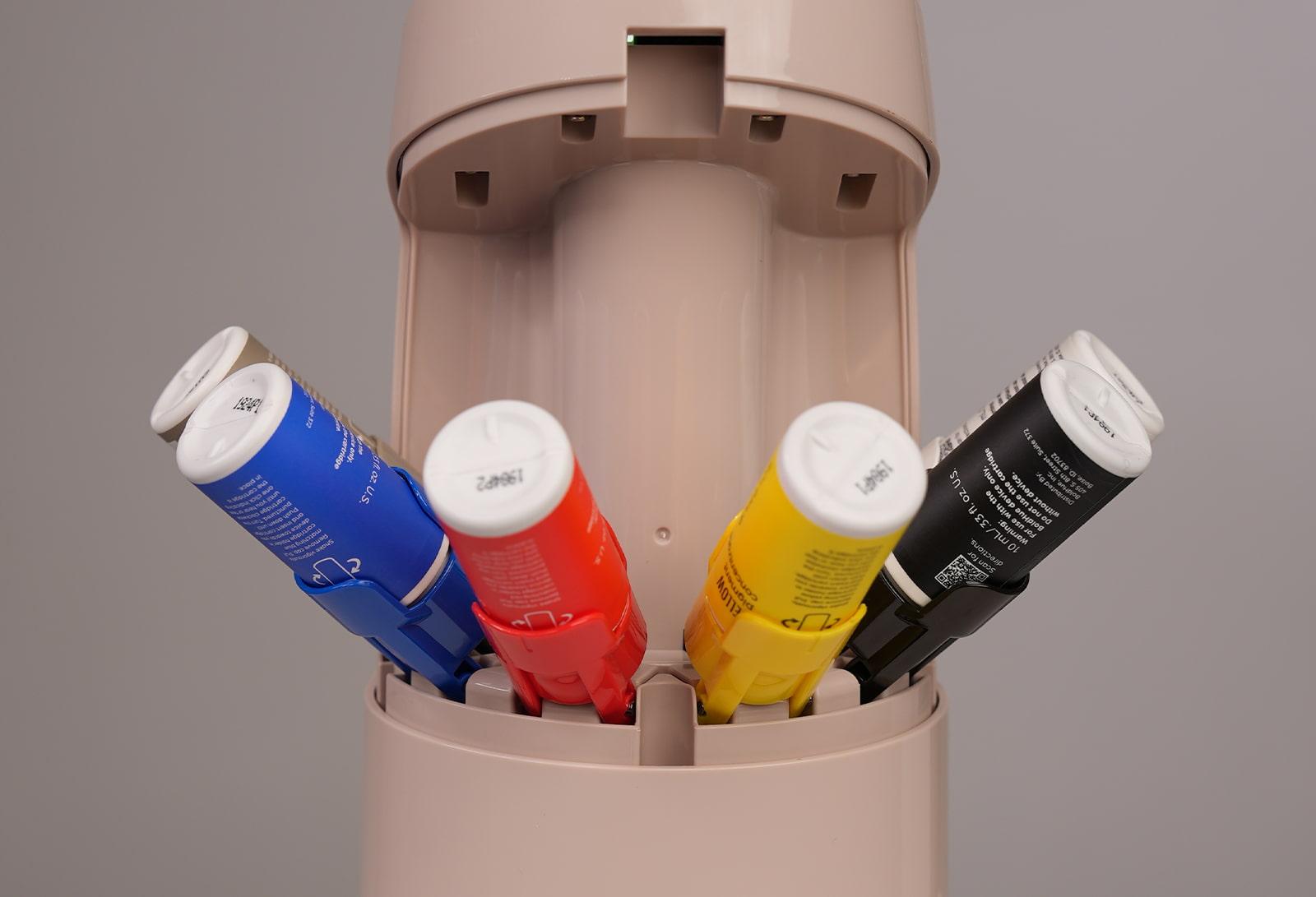
BoldHue’s at-home countertop device, which scans the skin and can generate millions of foundation shades, completely eschews the smartphone. Priced at $295, BoldHue’s starter kit comes with one month’s worth of foundation pigment cartridges, plus a light-blocking wand used to scan three areas of the face: the forehead, the cheek or chin, and the neck.
“We get a lot of sun on our forehead, not so much under our neck,” explained Wilson. “We need to find the aggregate of our skin tone.”
The approach has worked, as Wilson said BoldHue sold out its initial run 60 days after its February 2025 debut, generated a 40,000-person waitlist, and won design and invention accolades from publications including Fast Company and Time Magazine. BoldHue’s early business is focused on direct-to-consumer, but Wilson said professional makeup artists are also a valuable client base, bringing the startup’s tech to movie and television sets at Netflix and Disney.
Brick and mortar is next on her agenda for 2026, as Wilson said most beauty purveyors offer roughly 50 shades, but retailers stock only 20 SKUs per brand. “We are having conversations behind the scenes right now,” she said of her active pitching to bring more shade inclusion and customization to retail. “Consumers are getting so loud that they are not represented within this 50-shade line.”
Perfect Corp. has sold its AI-enabled face analysis technology to beauty brands since 2017, beginning with Estée Lauder. Newer clients include e.l.f. Beauty, Clinique, MAC, and Tarte.
The company sells shade finder technology that can assess skin tones and make more accurate foundation product recommendations through online experiences like a mobile app and in retail stores, the latter requiring an associate to scan a customer’s face with an iPad or other smart device, and use the analysis to guide a sale.
Australia’s Bondi Sands saw shoppers linger 162% longer on the self-tan and suncare brand’s website after launching an AI-enabled virtual try-on tool. 60,000 people scanned a QR code on retail shelves that guided shoppers to the technology, according to Perfect Corp.
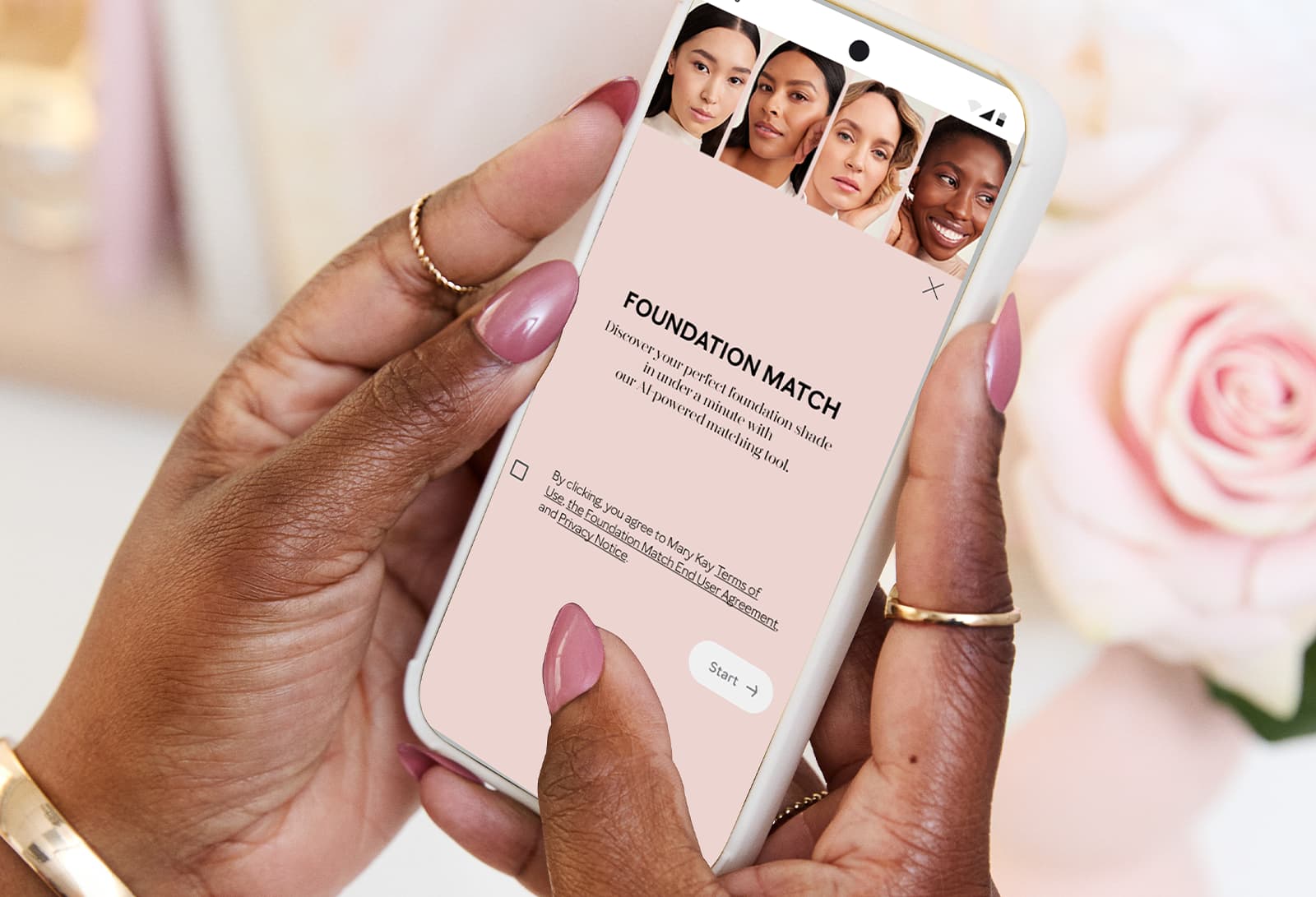
Last year, Mary Kay rolled out its AI-enabled Foundation Finder, which captures 151 facial feature points. The matching tool then bases recommendations on a proprietary 10-shade scale that analyzes a user’s skin tone and matches it to the red, green, and blue values found in the cosmetics company’s product line. “The application uses machine learning to continuously improve the accuracy and results and recommendations,” a Mary Kay spokesperson told BeautyMatter.
The Foundation Finder, which has rolled out globally to more than 30 markets since its debut, does require quite a bit of upfront education to ensure users capture a proper image. Accurate readings require bright, even light, and potential shoppers are told to pull their hair back, make sure the camera is positioned level with their face, face forward with a neutral expression, and have a clean face with no makeup or glasses on.
“When it comes to lighting, we very early identified it to be a key component to run the Foundation Finder,” Mary Kay’s spokesperson said.
As beauty brands refine AI shade matching, the biggest breakthrough may hinge less on algorithms and more on who can truly digitize skin tone.