





Charlotte Mensah has spent four decades building one of the UK’s most influential Black-owned beauty businesses, and she has done it entirely on her own terms. The Ghanaian-British hairstylist opened her first salon, Hair Lounge, in Kilburn in 1999 with a grant from the Prince’s Trust (now the King’s Trust), before relocating to its current home on Portobello Road, in Notting Hill. In 2016, she extended the business beyond the chair with the launch of her haircare line, anchored by the now-cult Manketti Oil; and in 2018, became the first Black woman inducted into the British Hairdressing Hall of Fame.
This September marked 40 years since a 16-year-old Mensah joined the youth training program at Splinters, London’s first Black hair salon. The brand marked the milestone with “Charlotte Mensah: Community Matters,” a mixed-media retrospective staged at Ladbroke Hall, Notting Hill, from September 8-13. Sponsored by Shark Beauty and curated by Dr. Madeleine Haddon, Senior Curator at V&A East, with creative direction from Jacqueline Douglas and production by Bashiru Lawal-Shardow, the exhibition doubled as both a celebration of Mensah’s career and a case study in how a hairstylist-turned-entrepreneur has built commercial longevity through restraint rather than expansion.
Speaking to BeautyMatter alongside Lawal-Shardow, Mensah laid out a fully self-funded business philosophy that runs counter to current prevailing beauty-industry logic, including deliberately limited SKUs, an emphasis on consumer education over product proliferation, and a retail strategy now tilting hard toward DTC.
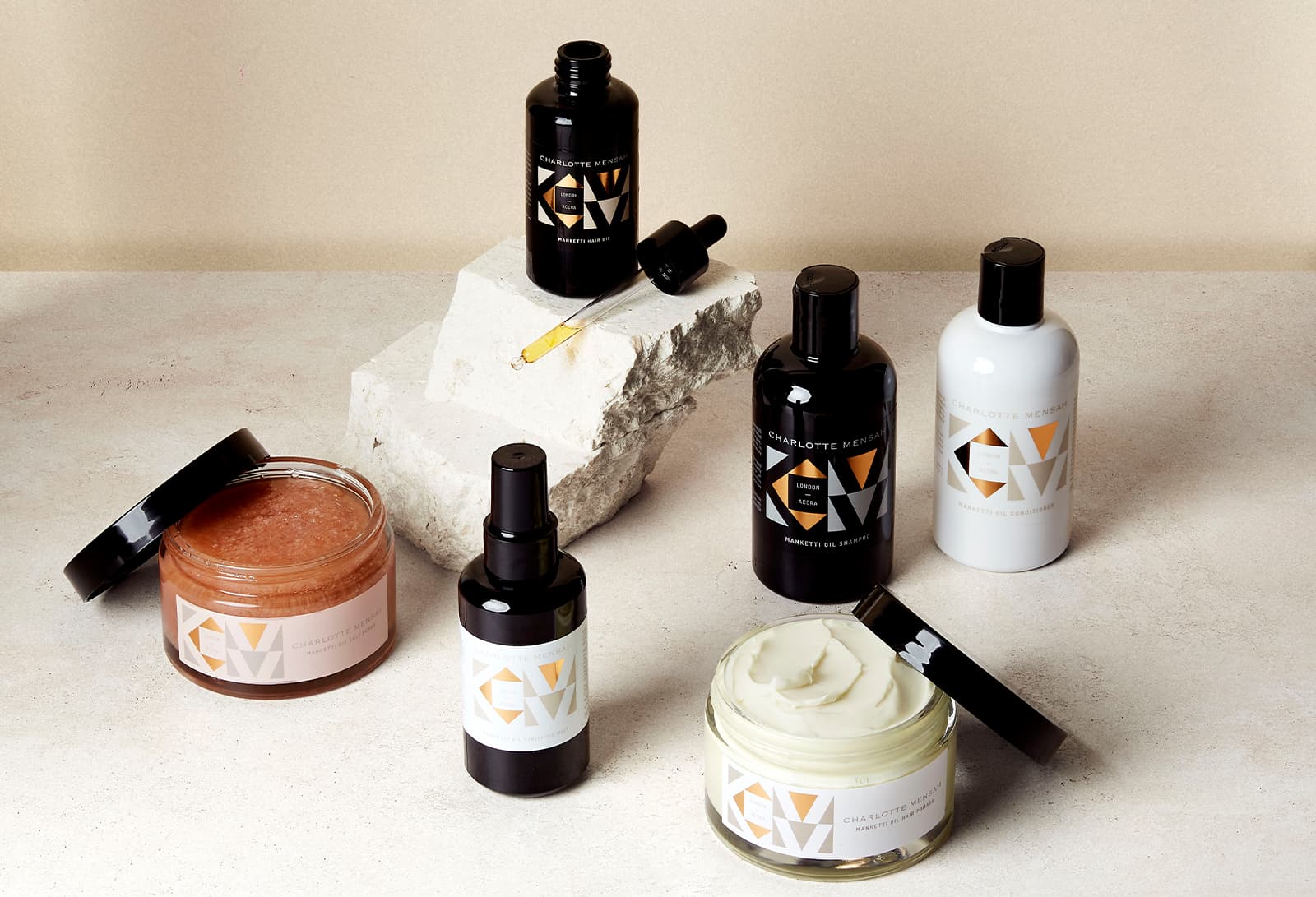
Mensah’s product range has stayed narrow by design. “Even though we’re ten years in the business, most brands have about five different types of shampoo. We still only have the one shampoo, the one conditioner,” she said. That restraint, she argued, is a necessary response to an oversaturated market. “I don’t think the world needs any more. What the world needs is education.” She pointed to how the same shampoo, used correctly (left on longer on a second wash to penetrate the hair shaft) outperforms a shelf of alternatives, and criticized brands that make customers cycle through products without loyalty or results.
The company builds multifunctionality into existing SKUs instead of simply adding more. “The pomade could be used to slick hair. It could also set the hair. It could be used as a leave-in conditioner. It can be used to twist the hair out,” she said. “So, one product can do eight different things.” The brand’s approach to sustainability follows the same logic: Packaging is designed for reuse. Its oil bottles can be repurposed as vases, and pomade jars as storage containers, reducing waste while extending the product’s presence in the customer’s home.
Still, the brand isn’t static. And in spite of Mensah’s commitment to maintaining a streamlined assortment, the company is developing new SKUs, including a dedicated leave-in conditioner and a hair mousse, calling them necessary things that the hair needs, rather than trend-driven additions. She also cited the brand’s exfoliating scalp scrub, launched in 2021, as a recent standout, now one of its most requested treatments in the salon, reflecting an interest toward scalp health as a category driver.
As far as distribution goes, Mensah’s brand is carried across a wide range of UK distributors including SpaceNK, Liberty, Selfridges, Thirteen Lune, and Debenhams in the UK. In the US, the brand is sold at Dermstore. A prior push into South Africa has stalled. “We did have one [retailer] in South Africa, but they’re having some problems at the moment,” she said, without elaborating further. Calendar collaborations with Liberty, Vogue, and Selfridges have served as a recurring brand-visibility play alongside core retail listings.
But perhaps the most significant shift is the DTC momentum the brand currently has. “We’re having a lot of really good DTC [growth] at the moment, [and] the last few months have been huge,” Mensah said, adding that a website overhaul is in progress to streamline the shopping experience. “That’s where we would really make a big mark,” she said, citing earned media as a discovery driver she expects to convert into new-customer growth once the upgraded site is live.
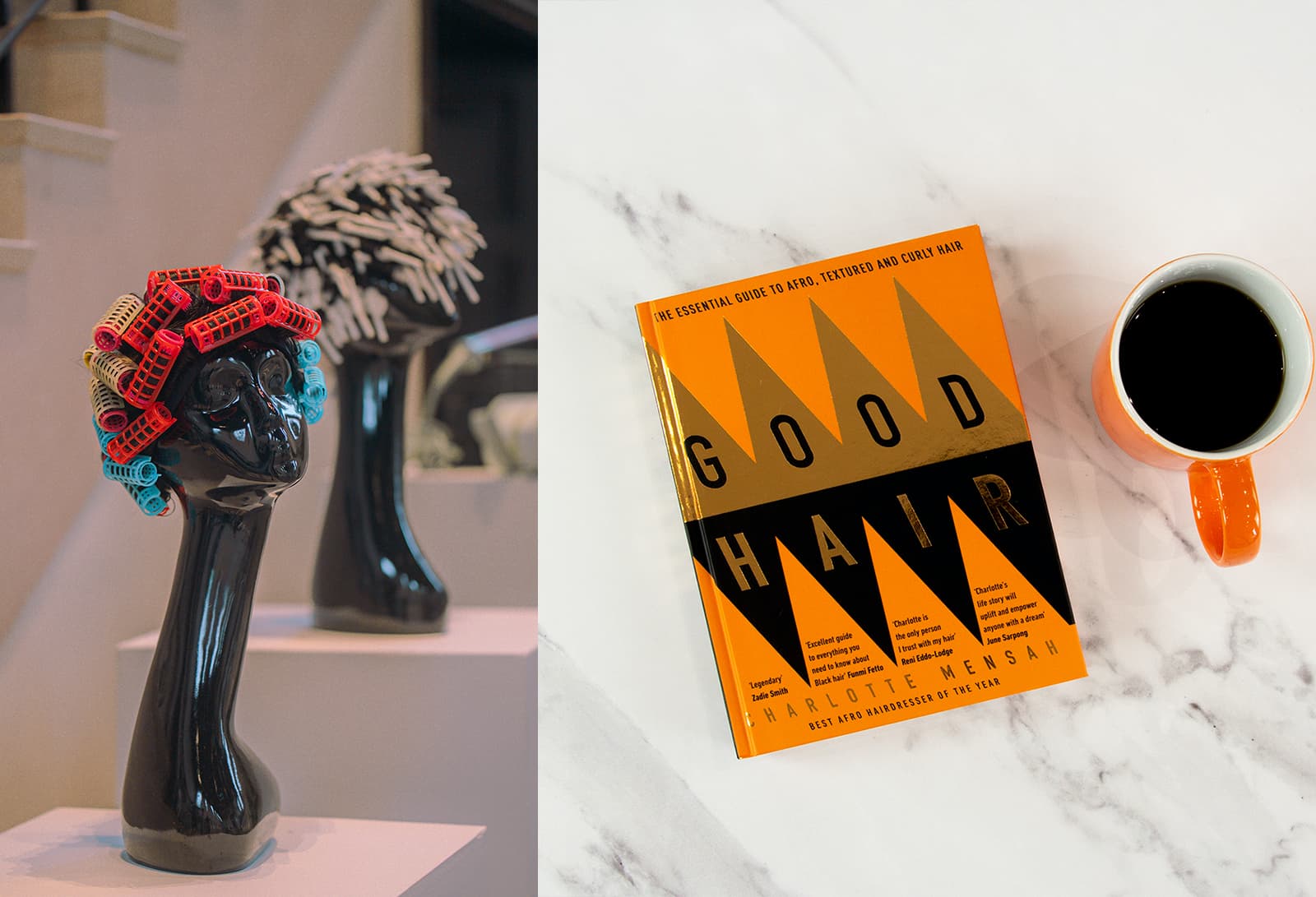
The “Community Matters” exhibit functioned less as a marketing activation than as an act of institution-building. Producer Lawal-Shardow said the project was “born out of, firstly, a desire to really mark the occasion of 40 years of dedication to a vocation, but evolved into an inquiry.” He described it as an examination of the infrastructure that enabled Mensah’s career, from her youth training apprenticeship to the Prince’s Trust grant that funded her first salon. “We had all of these things to allow someone to get to 40 years,” he said. “What are we going to do to allow the next person to get to 80 years, and more people at that?” he questioned.
The show’s creative team was itself proof of concept for its title. Both Dr. Haddon and Jacqueline Douglas began as Hair Lounge clients before becoming collaborators. “What ties these two people to Charlotte in particular is that they both started off as clients of hers,” Lawal-Shardow said. The exhibition centered on an “inner sanctum” of five kiosks styled like West African and Caribbean market stalls, evoking the hairstyling shop Mensah’s grandmother ran in Ghana, alongside archival editorial work, mannequins styled to depict various eras of Mensah’s career, and salon furniture—including chairs and a worktable—physically relocated from Portobello Road. Alexandros Kosmidis, the graphic and visual design lead for the exhibition, purposely used a Ghanaian typeface, which was stencilled on the kiosks to enhance authenticity and context.
A key installation juxtaposed Mensah’s first-ever styling tools, bought 38 years ago, against a Shark Beauty Silky Pro Straight tool weighing under 1kg (2.2 lb.). “You’re really trying to impress on people that time changes and innovations happen,” Lawal-Shardow said. Shark Beauty’s role as lead sponsor was framed as a deliberate departure from typical brand-hairstylist partnerships. “There’s a very easy way for a beauty brand to get involved with a hairstylist who they think has a big profile,” he said, arguing that backing an exhibition instead signaled genuine investment in Black hair expertise rather than a transactional relationship.
Programming ran throughout the week including a media preview; an intergenerational business panel moderated by the CEO of British Beauty Council, Millie Kendall, featuring veteran stylist Errol Douglas; another panel examining the salon as a cultural institution moderated by Vogue’s Funmi Fetto; and a closing party tying music, archive, and community together. A quarterly parent-and-child haircare workshop Mensah runs at her salon was also brought to the venue, and local charities and students from a primary school were invited to participate, deliberately widening access beyond a paying, retail-ready audience.
Mensah was candid about where she sees the wider industry falling short 40 years on. Despite far greater retail access than when she started, “there weren't any Black products there for any of us in mainstream shops in the 1980s,” she said. She also argued that formal training has eroded. “There’s a lot of people practicing whatever they’ve learned from [AI],” she said, contrasting it with the older apprenticeship model that required years of practice before building one’s own client base. For a brand built on patience and a stripped-back SKU count, that critique doubles as a mission statement that growth can be measured in decades, not drops.