





Key Takeaways:
For years, retail was viewed primarily as a means of distribution: getting products into consumers' hands. But in today’s beauty landscape, retailers do far more than just put products on shelves. Beauty retailers validate brands, shape discovery, translate trends across markets, and, increasingly, determine which ones break through and unlock that next level of growth.
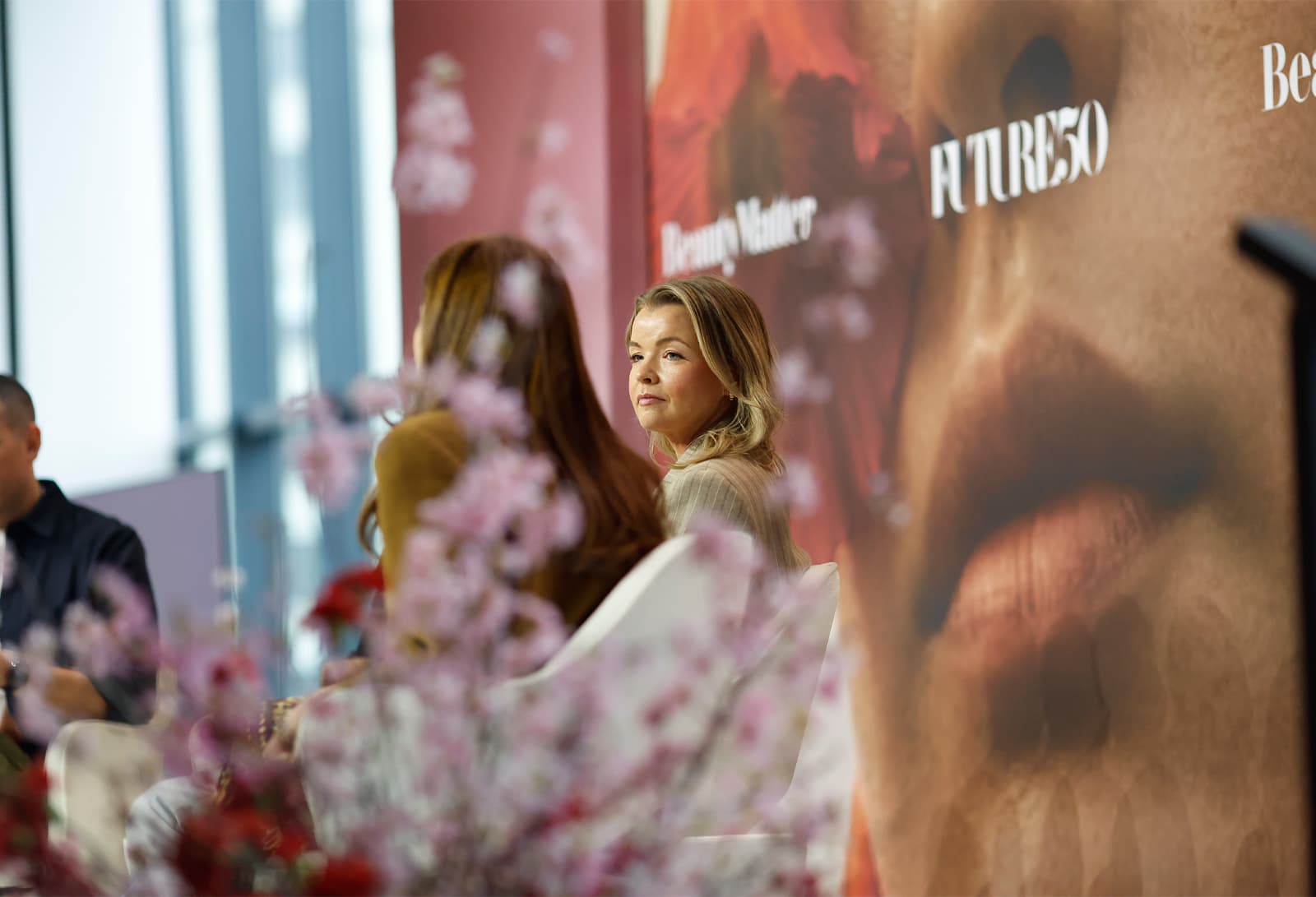
At BeautyMatter’s recent FUTURE50 Summit in New York City, BeautyMatter co-founder and President John Cafarelli convened three retail operators from distinct markets and business models for a panel titled “Gatekeepers of Growth: How Retailers Will Define the Next Era of Beauty.” The discussion featured Grace Vernon, head of Boots Ignite, Foresight and Trends at Boots UK; Jessica Matlin, Director of Beauty and Home at Moda Operandi; and Philipp Mehler, co-founder and CEO of Berlin-based Purish. Mohammad Alshammari, International Business Development Manager at Boutiqaat, a Kuwait-based e-commerce and social selling platform, was also scheduled to join the panel but was unable to attend due to the ongoing conflict in the Middle East.
Cafarelli opened the discussion by painting a picture of today’s fragmented retail environment. “The customer journey has been completely turned on its head, with creators morphing into mini retailers, social selling gaining real traction, and platforms like TikTok presenting consumers with millions of discovery and purchasing opportunities every single day,” he told the audience.
“Retailers today are now curators, they're validators, they're translators, and increasingly they are the infrastructure that allows brands to scale globally,” Cafarelli continued. “In a category defined by speed, saturation, and constant newness, this ability to curate and thoughtfully and strategically bring products together has become one of the most important forces shaping our industry today.”
How Boots Ignite Takes Brands from “URL to IRL” in Record Time
For Vernon, whose Boots Ignite program was designed to identify and rapidly scale high-potential emerging brands, the rise of social commerce has sharpened the importance of stores.
“There are more products, brands, trends, and innovations than we've ever seen before, which means it is very competitive, but that also means we have such an engaged consumer base within beauty, so we can target them really well,” Vernon said to the crowd. “Ultimately, we work in such a sensorial category. You want to smell the fragrance, feel the texture, see the color match, and make sure that foundation shade is right for you, and physical retail plays such an important role within that.”
That physicality continues to matter, even as digital discovery explodes. Vernon pointed out that while predictions during the pandemic centered on “the death of the high street,” Boots instead doubled down on stores. The company’s view, she said, was that consumers still wanted real-world experiences with products and brands, which is increasingly valuable in an era of screen fatigue.
According to Vernon, 90% of the UK population lives within a 10-minute drive of a Boots location. For brands, that makes the retailer a particularly powerful bridge between online hype and in-person trial. It is also the logic behind Ignite, which she described as a program built around taking brands from “URL to IRL.”
The Boots Ignite program focuses on two key types of brands: first-to-channel brands that are already gaining traction online and are being brought into physical retail for the first time, and first-to-market brands from other regions, such as the US, Korea, China, or Australia, that Boots is introducing to UK consumers.
One of Ignite’s most notable differentiators is speed. Traditional retail launch cycles can be slow, often tied to annual or semiannual category resets. Vernon said Boots’ broader category timelines still work that way, but Ignite was created specifically to respond more quickly to cultural momentum. The program can launch a brand in as little as eight weeks.
Boots uses internal sales and loyalty data from its 17 million active Advantage Card members, along with external AI-based market intelligence platforms that track signals such as TikTok views, Google searches, ChatGPT queries, and Instagram engagement.
Those tools help the team determine whether a brand is experiencing sustained growth rather than just a short-lived spike. But data alone is not enough. Vernon made clear to the audience that the product itself has to hold up. “The most important part,” she said, “is a great product, and a great product that is truly a great product, not just a viral product.”
That longer-term view shapes how Boots approaches partnerships. Vernon repeatedly returned to the idea that brands only get one real shot at entering retail successfully. As a result, Ignite is designed not just to accelerate listings, but to support founders, particularly those with limited operational experience, through the realities of retail scale.

The Strategic Case for Specialized Retail
Moda Operandi, on the other hand, operates on a smaller scale than Boots, but the role of curation is just as deliberate. Matlin described the luxury e-tailer as a fundamentally distinct kind of beauty partner; one that is not built around volume, but around brand world–building. Moda Operandi began as a fashion-first trunk show business, built on the idea of allowing clients to shop runway looks almost immediately.
“Moda Operandi has always been about fashion first,” said Matlin. “When we started the beauty category, it was about rounding out that full lifestyle and buying into brands that feel really like a fashion brand. The brands that succeed on Moda Operandi are brands that are not necessarily problem/solution or something that feels like a viral TikTok moment, but brands that feel like aspirational fashion brands.”
She cited brands such as Westman Atelier, Fara Homidi, and Violette_FR as examples of beauty brands that succeed because they are built like fashion brands. These brands, and others on Moda Operadi’s site, cater to the emotional beauty buyer and succeed by selling a lifestyle they aspire to inhabit.
Like Moda Operandi, Purish is also a digitally native platform, with its primary focus being Germany and the wider European market. According to Mehler, the structures, consumer behaviors, and pricing expectations that shape brand growth in the US don’t necessarily translate abroad. He told the audience, “In Europe, and in Germany especially, many people tend to browse and buy offline, so if brands really want to make a big impact in the market, they should be in brick-and-mortar stores.”
Large German chains such as dm and Rossmann operate thousands of stores, many located close to where consumers live. “Germans are very price sensitive, so they don't want to pay for shipping,” Mehler said.
Retailer Readiness
Timing, the panelists agreed, is one of the biggest determinants of success. For Vernon, a red flag is not necessarily a brand’s immaturity or lack of polish, but a lack of transparency. If a brand is not financially or operationally prepared, Boots would rather revisit the opportunity later than force a premature launch.
“If Boots is interested, the door is always open,” said Vernon. “We're interested when you're ready, so come back and let us know, because you only get one chance to launch in retail, and if it doesn't perform, it's really hard to get it back in.”
In Germany, Mehler said, the biggest opportunity for brands often sits in drugstore-style formats that offer premium appeal at lower- or mid-tier pricing in what he referred to as “truck stores.” He compared it to CVS in the states but with more premium appeal. “If you want to be successful in Germany, you should be there, because the premium retailers are quite limited,” he said. Prestige beauty exists, but the channel is more limited, with Douglas, a German perfume and cosmetic company, dominating much of the market and Sephora playing a smaller role than it does in the US.
For brands entering Germany, that means recalibrating assumptions. A brand considered as prestige in the US may need to rethink where and how it fits into Europe. Mehler suggested that one of the strongest positioning strategies for the market is to offer a blend of perceived quality and desirability at accessible pricing.
He also emphasized the importance of local validation. One of the clearest indicators that a brand might resonate in Germany, he said, is when local experts are already talking about it, because it demonstrates market awareness.
“Many brands underestimate that people want to buy a brand with a recognizable founder,” Mehler added. “They want to know who was building that brand, why it was built, and what is the mission of the brand. That's something I very carefully look at, and if a brand has both of those things, there’s a good chance that it’s ready for retail.” Purish’s role, he said, is to operate as an extension of the brand’s team. The retailer helps determine the right marketing strategy, build awareness through PR, influencer work, expert partnerships, events, and in-store activity, and whatever else it takes to make the brand feel tangible in the market.
Matlin was candid about Moda Operandi’s limits as a smaller beauty retailer. While the platform has substantial reach, credibility, and nearly 3 million social followers, it is not a scale player on par with the major beauty retailers of the world.
“If a brand wants to launch at Moda Operandi, they need to be eyes wide open that we're not a volume player,” she warned. “It's almost like an art house. You're not going to be doing the volume that you would be doing at Sephora.”
For brands, that means entering the partnership with clear expectations. Launching at Moda Operandi may confer cachet, visibility, and alignment with a high-spending luxury customer, but it is not likely to be the sole engine that transforms a company’s financial trajectory.
That honesty appears to have shaped Matlin’s own thinking over time. Early in building Moda’s beauty assortment, she placed greater emphasis on exclusivity. But she said she quickly learned that maintaining a constant pipeline of exclusive launches is difficult and not always in the best interest of either party.
“It's good to have some exclusives, but it's not realistic to have all exclusives, because then you lose them [to retailers like Sephora or Amazon Luxury], and then to keep replacing them is very hard,” said Matlin. “It’s a great show of faith from brands to be exclusive with us, but it benefits Moda Operandi to have brands that have limited distribution, so that’s the way forward for us right now.”
The retailer’s real strength lies in storytelling and context. Matlin described activations, pop-ups, editorial treatment, and high-touch client experiences as some of the most effective ways Moda Operandi builds awareness for partner brands. Beauty is frequently layered into larger fashion- and lifestyle-driven moments: private client events, fashion week experiences, branded suites, and cross-category merchandising programs that connect skincare, makeup, fashion, jewelry, and home.
Cafarelli asked an important question: Are these opportunities pay-to-play for brands? Not always, according to Matlin. Digital touchpoints, such as asking actress Chloë Sevigny to share a list of her favorite beauty products available on the site, won’t cost a brand anything, but large-scale activations and pop-ups in partnership with Moda Operandi will come with a fee for brands to participate in.
The conversation demonstrated the vast power of retail for the brands who are ready and willing to take that next step. Retailers are gatekeepers, but not only because they decide who gets through. They also shape the terms of growth itself. The most effective retailers today function as strategic partners with distinct points of view, different market logics, and highly specific expectations of what success looks like. To scale, brands need to be ready to jump into the deep end with a retailer, knowing that the success of that partnership determines if they sink or swim.