South Korea’s cosmetics industry has become one of the country’s most dynamic export engines, transforming from a cultural curiosity into a high-value sector that climbed to record levels last year. The Ministry of Food and Drug Safety reported $11.4 billion in cosmetics exports in 2025, up 11.8% from the previous year and a record high, becoming the world’s second-largest exporter of cosmetics. France leads global cosmetics exports, accounting for $24.3 billion, and the US now ranks third at $10.8 billion.
The UAE ranked 8th globally among all Korean cosmetics export destinations in 2025, up from 12th in 2023, making it one of the fastest-rising markets in Korea's entire export portfolio. The UAE and Saudi Arabia are the primary points of entry into the GCC. According to the Korea International Trade Association, cosmetics exports to the UAE reached $286.5 million last year, up 67.2% from the previous year. Exports to Saudi Arabia, up 34.1%, and exports to Kuwait, up 55.5%, also surged.
Korean beauty companies have been actively cultivating the Middle Eastern market. At Beautyworld Middle East 2025, 274 K-beauty brands and companies participated, including Medicube, Aekyung Industrial, COSRX, and Centellian24.
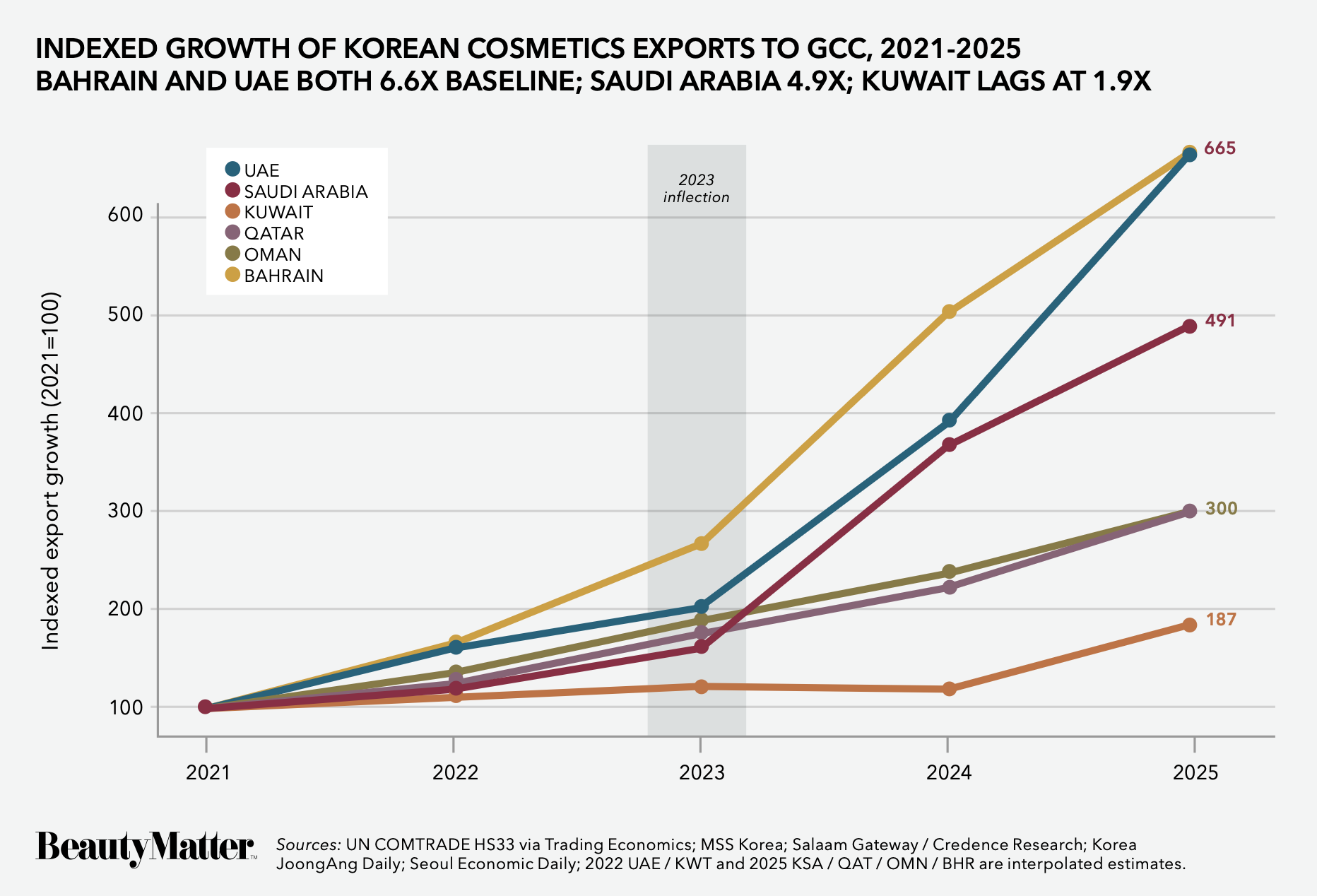
The GCC and South Korea signed a Free Trade Agreement in 2023, eliminating the standard 5% import tariff previously applied to Korean cosmetics in GCC markets. This tariff removal dramatically boosted the price competitiveness of South Korean skincare and makeup products across the region.
Minister of Agriculture, Food and Rural Affairs Song Mi-ryung announced this year that the South Korean government will focus on expanding the agreements to support domestic private halal certification agencies. Diplomatic efforts to expand Korea’s network of partner countries through mutual recognition agreements (MRAs) for halal certification will further boost exports to global Muslim markets, including the GCC. The expanded halal cosmetics certification training and the removal of structural entry barriers will provide a competitive edge, especially in Saudi Arabia.
What began as a wave of interest in Korean skincare has matured into a global industry with a measurable impact on Korea’s export diversification strategy. Kim Byung-ho, Director of KOTRA's Middle East Regional Headquarters, said, “With the diversification of supply chains, the Middle East is a strategic alternative market where Korean consumer goods can grow by avoiding tariff barriers,” adding, “We will actively support the spread of Korean consumer goods, such as K-beauty, in the Middle East with the UAE as a hub.”
Hallyu as a structural demand engine. K-pop fandom and social media influencers are converting cultural affinity into purchase behavior at scale. The Korean Wave K-pop, K-dramas, and viral content, have moved from cultural curiosity to purchasing infrastructure. GCC consumers, particularly Gen Z and millennials, have developed parasocial relationships with Korean talent that translate into product curiosity and brand loyalty.
Regionally relevant. Consumers are increasingly captivated by the playful innovation and sensorial appeal of Korean beauty, with sheet masks, ampoules, and gel-based textures remaining staples in both personal and professional routines. These formats, glass skin, and dewy aesthetics are considered effective for the region's hot climate.
Gen Z demographics and ingredient fluency. In the GCC, Gen Z is a disproportionately powerful consumer cohort. According to the Chalhoub Group 2024 Beauty Report, 60% of GCC Gen Z cite skincare as their top beauty purchase reason, and 91% of Gen Z consumers in Saudi Arabia describe themselves as ingredient-informed. K-beauty's communication architecture, built around active ingredients, layering logic, and a visible mechanism, maps to these consumers.
From country-of-origin to formula rationale. One of the most significant structural changes underway is that GCC consumers are no longer asking for "Korean skincare"—they are asking for heartleaf extract, centella asiatica, rice ferment, snail secretion filtrate, and niacinamide by name. This is a maturation signal. It means K-beauty has successfully seeded ingredient fluency into the market, creating stickier loyalty: Consumers are attached to the formulation, not just the flag.
Halal alignment and natural ingredient perception. Korean brands have been proactive about halal certification, and the cruelty-free positioning that characterizes most K-beauty branding creates a natural affinity with Muslim consumer values even before formal certification. Clear skin outcomes, natural or plant-derived ingredients, and innovative technology all map onto K-beauty's brand language.
Accessible efficacy positioning. K-beauty occupies a mid-market tier that European prestige brands cannot. It delivers visibly functional results at a price point below Lancôme, La Mer, or Nars. This is particularly relevant in markets like Kuwait and Qatar where purchasing power is high, but the mid-market luxury tier has historically been underdeveloped. Triton Market Research pegs MEA K-beauty at a 9.05% CAGR, with UAE already at $35 million in 2023, and the growth trajectory is steepest in the affordable-premium segment rather than mass or ultra-luxury.
Digital commerce and social discovery. Instagram is the dominant beauty discovery platform for GCC Gen Z, with TikTok as the secondary platform. Chalhoub Group reports a 22% increase in skincare conversations in Saudi Arabia in 2024 alone, citing Meta platform data. Regional influencers and Korean celebrity beauty content serve as the primary awareness layer. The social, discovery, transaction pipeline is compressing, particularly for serums and sheet masks, where trial friction is low, and repeat purchase is high.
CJ Olive Young, the retailer at the forefront of K-Beauty's globalization, with an assortment across more than 1,390 stores in South Korea, has the Middle East in its sights. The retailer signed a memorandum of understanding with local distributor Life Healthcare Group (LHG) in November 2026. The two companies plan to distribute K-beauty across 580 Life Pharmacy stores, a drugstore chain operated by LHG.
The new strategic partnership between Sephora and CJ Olive Young is set to launch in the GCC in 2027, with a dedicated zone curated by Olive Young, available online and in stores in the region. Priya Venkatesh, Global Chief Merchandising Officer for Sephora, said, “Korean beauty is one of the most innovative, fastest-growing, and desirable categories in beauty right now.”
The region is not new to the retailer. Currently, CJ Olive Young sells its own brands, such as Bring Green, WakeMake, and Colorgram, in Middle Eastern markets through wholesale partners.
Korea Town announced a collaboration with Boutiqaat Group, one of the Middle East’s leading beauty e-commerce platforms, to open 50 stores across the GCC by 2027. The collaboration will operate under the “Powered by Boutiqaat” model, a framework that enables Korea Town to leverage Boutiqaat’s established retail infrastructure, advanced logistics capabilities, and data-driven digital ecosystem to accelerate its regional rollout. This represents a key step toward building a scalable, culturally relevant platform that connects local consumers.
The expansion aligns with the redesign and relaunch of Korea Town’s flagship branch at The Gate Mall in Kuwait. The upgraded store concept reflects a more immersive approach to beauty retail, blending experiential design with the authenticity and cultural storytelling that define Korean beauty. The space introduces a modernized shopping experience centered on product discovery, innovation, and education, offering visitors a glimpse into the evolving landscape of K-beauty retail.
K-beauty's traction in the GCC is demand-led, not supply-led with retail infrastructure significantly behind where consumer pull already sits. The Sephora x Olive Young, Life Pharmacy x CJ Olive Young, and Korea Town x Boutiqaat distribution is strategically timely rather than speculative. This cross-cultural convergence points to a regional consumer who is curious, educated, and ready to embrace the best of both worlds, as long as the results live up to the hype.