K-beauty skincare, a prestige fragrance upset, and a mascara underdog story: Amazon's Prime Day 2026 report from Market Defense shows a more deliberate beauty shopper. She's spending less per order but coming back more often, chasing ingredients and brands she'd already researched on TikTok.
"Prime Day 2026 had a clear message for the beauty industry: Shoppers arrive knowing exactly what they want, and increasingly, what they want is prestige," said Vanessa Kuykendall, Chief Engagement Officer at Market Defense. "The power players this year rewrote the rules. Prestige won big, with Armani Beauty claiming the top fragrance spot and Tarte unseating Maybelline in makeup. K-beauty dominated skincare, with Medicube commanding nearly 16% share."
The event didn't post the explosive growth of last year's Prime Day (which grew 30.3% year over year (YoY)), and shoppers were noticeably more careful with their money. Average order size fell from $53 in 2025 to about $48 this year, and average household spend dropped from $156 to $143.45. But 63% of households placed two or more orders before the event closed, and 41% placed three or more orders. Rather than filling one big cart, shoppers kept returning for smaller ones.
Average price per item also slipped to $23.23, down 5.5% YoY, while items under $20 held steady at 69%-70% of the cart across all four days.
The typical Prime Day 2026 shopper skewed suburban, female, and 45 to 64 years old, with the 65-and-up group now making up 31% of buyers, up from 29% last year. More than half of shoppers (52%) compared prices at other retailers before checking out, and roughly 49%-50% cross-shopped at Walmart throughout the event. Deal satisfaction kept sliding too, dropping from 68% in 2025 to 59% this year, a trend Market Defense said it's now tracked across three consecutive events.
Shoppers leaned on other tools to stretch their budgets, too. Buy-now-pay-later transactions hit $2.04 billion during the event, up 5.5% YoY, and AI‑referred traffic grew sharply and converted better than email or paid search, though Market Defense noted this was a normalization from last year's 3,300% surge and converted 40% better than email or paid search. That's a big number on its own when AI-assisted shopping was still a novelty. Intent to shop was high going in, with 88% of Prime members saying they planned to participate, up from 81% last year. But the share of shoppers who cited Prime Day as their main reason for shopping continued to erode as the event went on, falling from 45% on Day 1 to 37% by close.
Beauty & Cosmetics ranked fourth among all categories purchased, at 26% of the cart, trailing only Apparel & Shoes, Household Essentials, and Health & Wellness. That 26% mark topped last year's 25% peak, and the category's share of the cart climbed from 22% on Day 1 to 26% by Day 2, holding there through the close.
Inside that 26%, one brand pulled way ahead of the pack. Medicube grew to a 13.23% overall share of sales, up from 9.3% in 2025, making it the top-selling beauty brand on Amazon for the second consecutive Prime Day. Within skincare specifically, its share climbed even higher, to 15.9%, up from 10.6% the year before. Its Toner Pads Zero Pore Pad 2.0 became the #1 best-selling skincare product of the event, up from #3 last year, and the brand's name held the #1 branded search term in skincare for the year to date, averaging just under 2 million monthly searches, up 47.6% YoY.
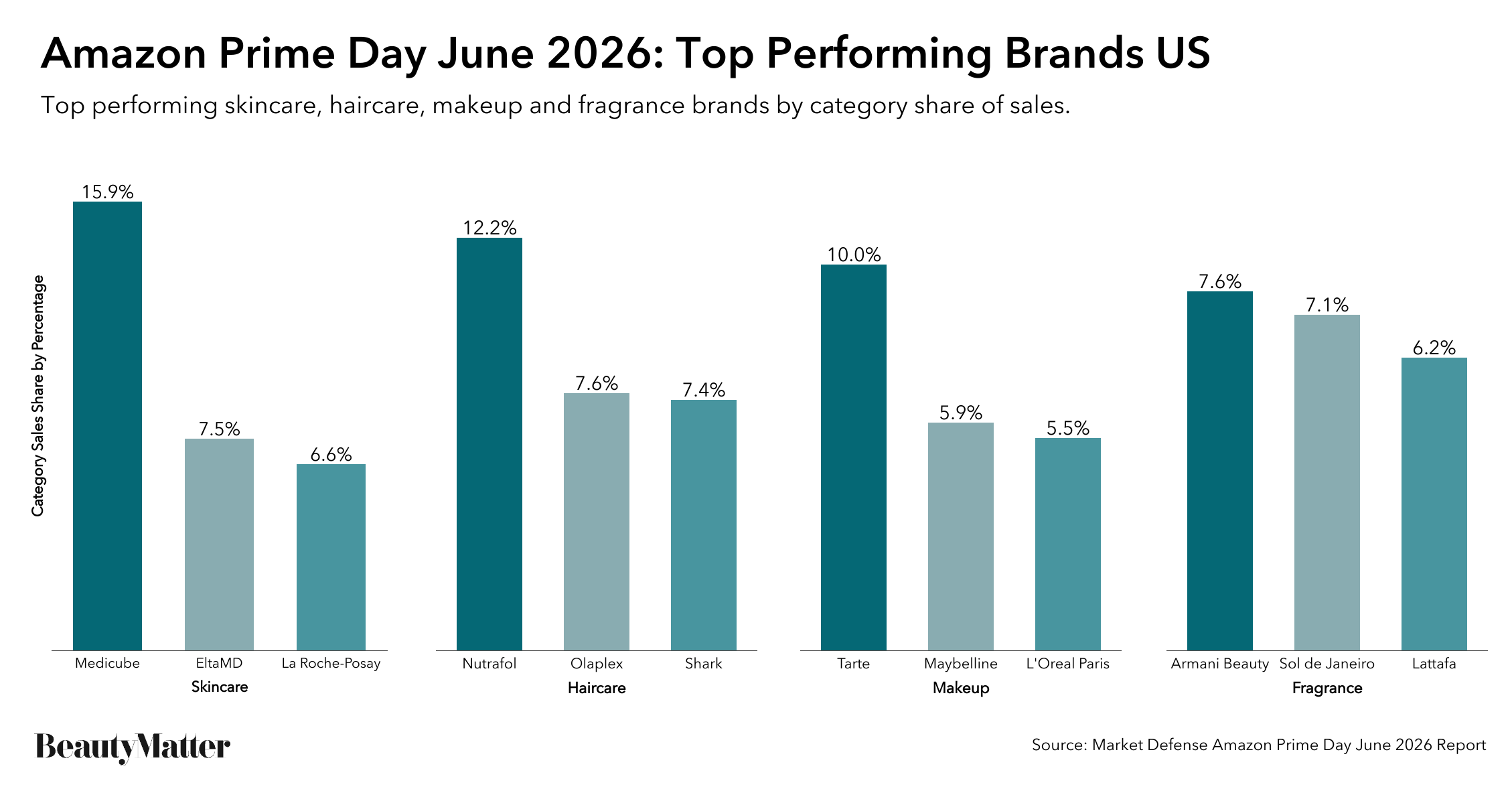
Prestige and challenger brands took over categories long held by mass-market names:
Tarte's rise stood out. The brand, which Market Defense's report noted was the #1 beauty brand on TikTok Shop back in 2024, unseated Maybelline as the top of makeup just 14 months after launching on the platform. Eye products drove much of that momentum, with six of the top 10 makeup bestsellers falling into that subcategory and mascara searches climbing 14% YoY to 1.4 million monthly.
Haircare told a more contested story. Nutrafol held onto the #1 brand spot for a second straight Prime Day and still claimed three products in the year-to-date top five, but its share dropped from 19.8% to 12.2% as challengers closed in. Shark was the category's breakout name, jumping from outside the top 10 to third place in brand share while surging 155% on TikTok Shop at the same time, a cross-platform push Market Defense compared to the playbook K-beauty ran in skincare. Hair tools overall surged 145%, the single biggest category lift across all of beauty this Prime Day, and searches for scalp massagers, scalp oil, and scalp treatments each climbed well over 100% YoY. Olaplex, Color Wow, and Pureology all lost share, and Revlon and Viviscal dropped out of the top 10 entirely.
Fragrance told a similar story of upgrades over habit buys. Sol de Janeiro's Cheirosa 62 Hair & Body Perfume Mist claimed the top spot for the third consecutive Prime Day, and men's fragrance brands Nautica, Afnan, and Rasasi took three of the top 10 bestseller slots, part of what Market Defense described as a category now growing nearly 9% annually.
K-beauty's rise on Amazon tracked closely with what was happening on TikTok. Hashtags like #koreanskincare and #skincareroutine racked up billions of views year to date, and #PDRN, the hero ingredient behind several Medicube bestsellers, generated 460 million TikTok views and showed up in 80,000 shoppable videos over the past year.
"Korean beauty brands captured 10.5% of all beauty searches on Prime Day 2026, up from 6.5% in 2025, and K-beauty alone drove roughly 19% of the entire Prime Day search lift," said Dave Karlsven, SVP of Partnerships & Growth at Market Defense.
Oral care emerged as a surprise trend leader this Prime Day, with seven of the top 20 trending hashtags falling into that category and #oralcare alone pulling 46.8 million views. Ingredient-led content around fluoride-free formulas and hydroxyapatite drove much of that conversation, and Market Defense noted the category was already building momentum across the 30- and 90-day windows before Prime Day amplified it further. Credential-led content held its own, too: #dermtok and #dermatologist combined for 23.3 million views during Prime Day week, a signal, Market Defense said, that shoppers are still looking for expert validation before they buy into clinically positioned skincare brands.
The broader search funnel showed shoppers doing their homework before they clicked buy. Beauty searches jumped 71% during Prime Day week compared to the two-week lead-in average, from about 102.4 million to 174.8 million. But click and purchase rates both fell, meaning traffic was more abundant but tougher to convert. Branded search kept gaining ground regardless, driving 20.2% of estimated beauty purchases, up from 17.4% a year earlier.
Not every subcategory surged evenly. Bigger-ticket, higher-consideration purchases saw the steepest search lift, with makeup up 97% and skincare up 82%, alongside a 145% jump in hair tools. Steadier, replenishment-style categories like oral care (+68%), bodycare (+52%), and haircare (+73%) grew too, but more moderately, since demand for those staples runs consistently year-round. Habitual, low-price categories like nails, lashes, and men's grooming grew the least, each up around 38%-42%, since a discount doesn't change buying behavior much for items shoppers restock out of habit.
Market Defense's team pointed to a common thread among this Prime Day's winners: They didn't wait until the event to start building demand.
Amy Rudgard, SVP of Client Strategy at Market Defense, said the brands that came out ahead this Prime Day weren't just lucky. "Our brands that outperformed this Prime Day shared a strategy, not a coincidence," she said. Off-Amazon demand-building was the clearest lever behind those wins, according to Rudgard: 60% of Market Defense's beauty brands activated support outside Amazon this year, up more than 30% over last year. That investment paid off especially well in fragrance, where creator-driven affiliate campaigns delivered a 7x return on ad spend overall and a 10x return within the category, which Rudgard said proves off-Amazon content converts hardest right when purchase intent peaks.
Jonathan Wilner, SVP of Commerce Media at Market Defense, framed the event in similar terms. He said the brands that came out ahead treated Prime Day as a conversion moment rather than a discovery one. "Prime Day is the time to convert the new shoppers brands have gained engagement with in the months leading up to the event," he explained. "It's harvest time, not planting time."
That same logic, invest before the event so you're ready to close during it, carried over to the storefront itself. Joshua Fulmer, Executive Creative Director at Market Defense, pointed to the brand storefront as one of the highest-leverage plays available as ad auction costs kept climbing across the category. "The investment is planning and execution, not just media spend," he said. The payoff showed up in the numbers: Fulmer noted that 71% of the brand stores Market Defense manages grew dwell time this Prime Day, and 58% saw improved conversion, even as paid traffic tightened industry-wide.
Prime Day 2026 reinforced that the cost of growth on Amazon continues to rise, said Karan Raturi, Chief Operating Officer at Market Defense. "The opportunity for the remainder of 2026 isn't simply to spend more; it's to spend smarter.” Raturi added that the brands that outperform will allocate capital toward their highest-return products, improve organic conversion, optimize for contribution margin over ROAS, and operate Amazon as an integrated commercial business as opposed to a collection of disconnected functions.
June's Prime Day landed just three weeks after a packed May promotional calendar that included both Mother's Day and Memorial Day, according to Taha Celik, VP of Supply Chain at Market Defense. "This Prime Day proved that inventory readiness is no longer a back-office detail; it is a real growth lever," Celik said. "Our team prepped brands to meet the demand of these back-to-back events, ensuring they were not left short on inventory at a critical moment."
With Amazon reportedly eyeing a possible move of Prime Big Deal Days into September, Market Defense's team said the planning window for the next event has already opened. As Kuykendall put it, the beauty shopper searches by brand and ingredient, not by category, which means the brands that build recognition now are set up to win whenever the next event lands.