
The K-shaped economy may be widening the gap between wealthy and financially stretched consumers, but beauty spending isn’t following as predictable a pattern. At BeautyMatter’s NEXT50 Summit, executives from beauty companies Elemis, Cosnova USA, and location analytics platform Placer.ai debated what happens when mass gets smarter, prestige gets scrutinized, and consumers refuse to stay in their lanes.
The K-shaped economy is supposed to be bad news for the middle. Wealthier consumers keep spending, those with less pull back, and everyone in between gets squeezed. For beauty, that raises an uncomfortable question: What happens to masstige when shoppers can get increasingly sophisticated formulas at mass prices or trade up to prestige for something special?
At BeautyMatter’s 2026 NEXT50 Summit in Los Angeles, Jeffery Wagstaff, CEO of Cosnova USA; Antonio Statelli, President of North America at Elemis; and Elizabeth Lafontaine, Director of Analytical Research at Placer.ai, joined BeautyMatter VP of Foresight and Intelligence Roseanna Roberts to examine whether the middle of the beauty market is really in trouble.
The answer was more complicated than the panel’s provocative title: Will the K-Shaped Economy Be the Death of Masstige Beauty?, might suggest.
Beauty may be resilient, but consumers are changing where they spend. According to Placer.ai, visits to beauty retailers increased approximately 3% in 2026, with masstige destinations growing faster than prestige. The real pressure is showing up in more traditional retail channels, including mid-tier department stores, drugstores, and pharmacies.
“We are kind of seeing the squeezing of the middle, but it's less about product and price and more about traditional versus beauty-specific,” Lafontaine explained.
Meanwhile, value-oriented retailers are attracting more shoppers. Visits to Walmart and Target increased approximately 2.5% year-to-date, while warehouse clubs and off-price retailers are gaining ground, according to Placer.ai. Costco, once better known for bulk groceries and household essentials, is increasingly becoming a beauty destination.
And the shoppers arriving at these retailers aren’t necessarily who brands might expect. Higher-income households are embracing value while lower- and middle-income consumers are redirecting some discretionary spending away from luxury apparel and accessories toward beauty.
The result is a consumer who might buy an affordable mascara, invest in a prestige moisturizer, and pick up the rest of their routine at Costco. Traditional price tiers are becoming less useful indicators of shopping behavior.
For Statelli, consumers have become much harder to impress.
“What we see is that she’s definitely gone forensic,” he said, pointing to the information now available through large language models and other digital tools. Shoppers can investigate ingredients, compare formulations, scrutinize claims, and question whether a $100 product really delivers five times the value of a $20 alternative.
K-beauty has made that comparison particularly uncomfortable for established players. Its combination of innovative ingredients, sophisticated textures, transparency, and accessible pricing has raised expectations across the market.
“It also brought something which was never a given, which is texture and sensoriality as a baseline and not anymore as a luxury,” Statelli said.
The ingredient gap between mass and prestige is closing, leaving premium brands with more to prove. For Elemis, that means emphasizing sustained performance and the experience surrounding its products, rather than relying on ingredients or price to communicate prestige.
Wagstaff sees the same competitive pressure from the mass side. Its brands, which include Essence and Catrice, must continually improve formulations, packaging, and innovation to compete for customers who are no longer shopping within rigid price brackets. “We can’t look like we’re staying as we were two years ago because then we’re going to look old. We’re going to look uninteresting,” Wagstaff told Roberts.
But Statelli identified an even more important dividing line than mass versus prestige: the difference between a product consumers try once and one they do buy again.
“What gets squeezed in the middle is those brands that she tried once and she didn’t repurchase,” he said. In other words, the real K-shaped economy in beauty may be playing out inside the shopping basket.

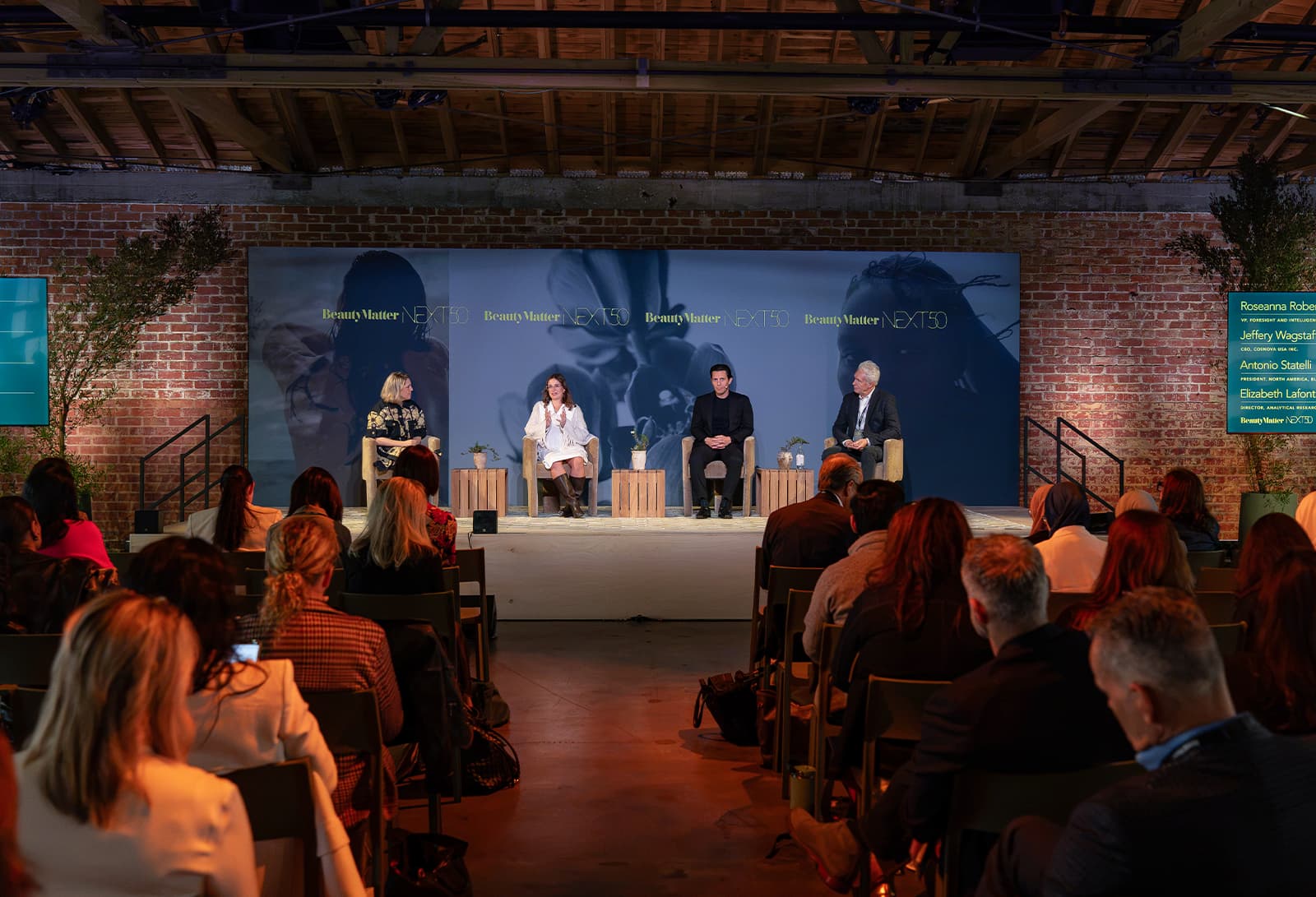
If consumers are scrutinizing value more closely, how much pricing power do beauty brands actually have?
Cosnova made a deliberate decision not to raise prices during the post-pandemic inflationary period and subsequent tariff pressures. For Wagstaff, maintaining affordability was about protecting the identity of a business built around accessible, high-performing products.
Price increases might have helped offset immediate costs, but they also risked undermining the trust and loyalty the company has spent years developing. Statelli was equally candid about pricing from the prestige perspective.
Wagstaff told the room, “The last couple of years between tariffs and inflation, I think they gave the industry a bit of cover that we mistook for pricing power.”
He argued that brands cannot simply charge more because their costs have increased or because they occupy a premium category. Pricing must reflect value consumers can recognize and verify.
That creates a difficult balancing act for masstige. Mass brands have scale and an increasingly compelling product proposition, while prestige brands have greater margins and the opportunity to differentiate through experience. The middle needs to offer a convincing combination of both.
Asked whether he would launch a masstige brand today, Statelli said, “What I would avoid at all costs is to sit not in the mid-pricing spot, but in the middle of their attention.”
His advice to founders centered on four priorities: develop a hero product with the potential to become a lasting franchise, establish something competitors cannot easily replicate, build the business around repeat purchases, and plan distribution well before expansion becomes necessary.
Lafontaine pointed to Target’s September Beauty Studio relaunch, which boosted the retailer’s visitation growth by approximately two percentage points, according to Placer.ai. The results reflect how retailers outside the traditional specialty beauty channel are competing for a greater share of consumer spending.
“What really makes the difference is how you show up,” Statelli told Roberts, arguing that each retail channel has a distinct role to play. Spas offer personalized treatment and immersive experiences, specialty retailers provide product discovery and trial at scale, while Amazon serves primarily as a customer acquisition channel. The challenge is making each work for the brand rather than treating wider distribution as an end in itself.
Maintaining competitive prices also requires finding efficiencies behind the scenes. At Cosnova, that means exploring how AI can improve inventory forecasting, assortment management, and day-to-day operations, helping the company absorb rising costs without passing them on to consumers.
Rather than signalling the death of masstige, the discussion exposed the challenges that emerge for beauty brands across every price tier when consumers have more choice, greater access to product information, and increasingly high expectations of what their money should deliver. K-beauty has narrowed the gap between mass and prestige, while changing shopping habits are forcing brands to reconsider everything from pricing and distribution to product development and customer retention.
For executives, the takeaway was that price positioning alone is no longer a competitive advantage. Whether launching at $15 or $150, brands need a compelling product proposition, a clear understanding of where and how their customers shop, and a business model that can sustain repeat purchases. The middle of the market is not disappearing, but there is increasingly little room for brands that offer neither the value of mass nor a convincing reason to pay more.


