Across Amazon's beauty landscape, a distinctive pattern is emerging: The legacy brands that once built their reputations on department store counters, salon chairs, and late-night QVC spots are finding new life in a channel once overlooked.
According to NielsenIQ, 53% of US beauty sales now happen online—a milestone reported in October 2025 as the first time digital has surpassed in-store purchases. Online beauty grew 18.7% in 2025, outpacing the total beauty category growth of 9.6%. Amazon alone has gained 7.3 points of retail beauty share since 2021. For legacy brands, this shift demanded a response.
“The shift to online shopping caught a lot of legacy brands off guard. Consumers discovered they could buy fragrance, hair color, and the newest eyeshadow from wherever they happened to be, and that convenience became the new norm,” says Vanessa Kuykendall, Chief Engagement Officer at Market Defense. “TikTok has been a remarkable equalizer for these brands, reaching two very different customers at once: the loyal buyer who’s now shopping in a new channel, and those discovering brands for the very first time. The TikTok-to-Amazon pipeline is now one of the most powerful conversion paths in beauty, and the brands on this list figured that out.”
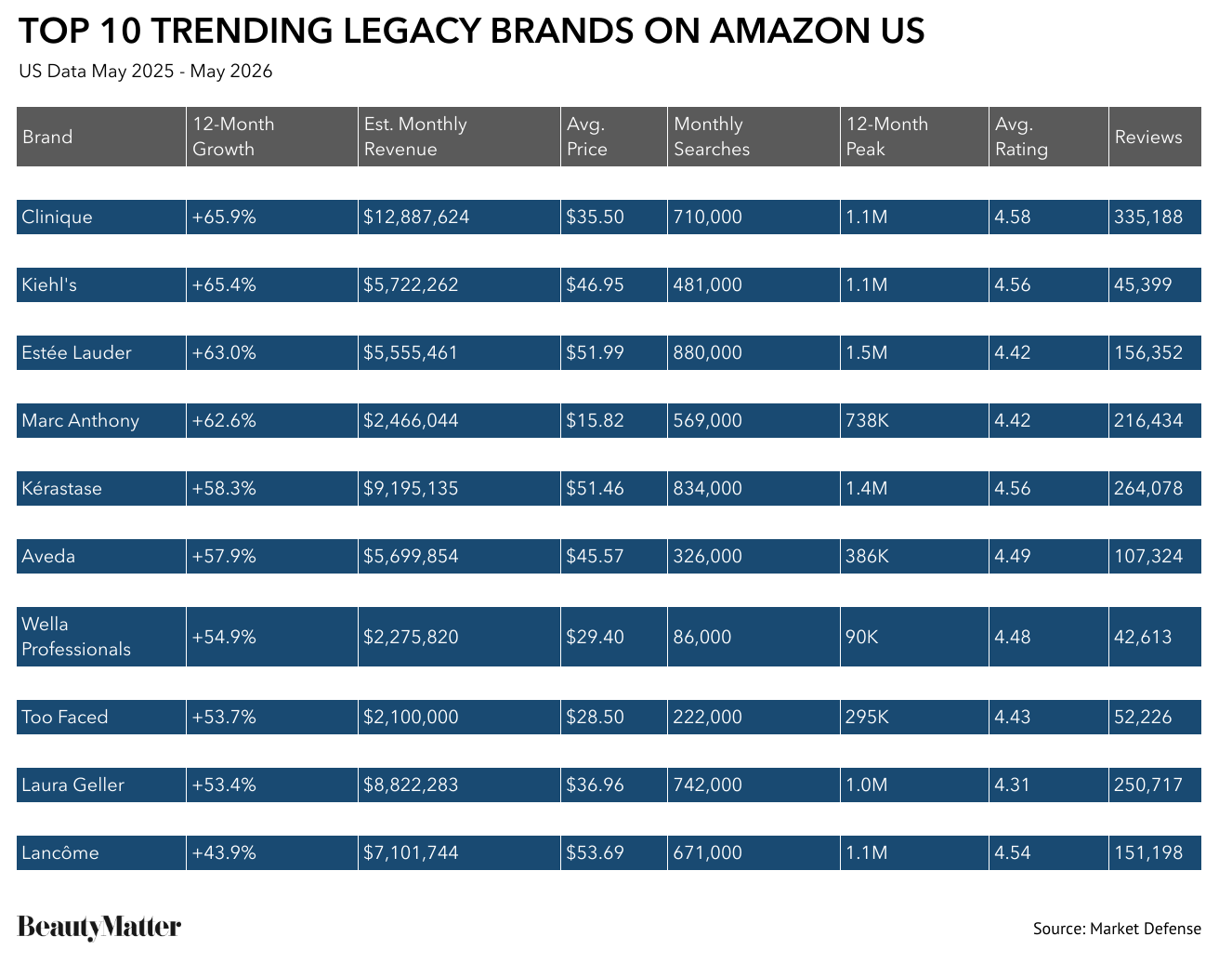
Market Defense, the full-service marketplace agency specializing in helping beauty brands grow on Amazon, analyzed data to identify the legacy brands (defined as founded pre-2005 with their primary distribution historically off Amazon) showing the strongest 12-month revenue growth. 40% of the brands on this list are owned by Estée Lauder, while 30% are L'Oréal owned, showing a significant corporate shift from the conglomerates to move their brands online.
In early May, Estée Lauder announced it would cut 9,000-10,000 jobs, with 70% of the cuts in its department stores. The conglomerate only entered Amazon in March 2024 when it launched Clinique. Since then, it has increased its Amazon storefronts from just three in 2025 to 11 to date. And L'Oréal has collaborated with Amazon on everything from an AI makeup “try-on” app to several case studies.
What follows is a ranked look at who’s back, why it’s working, and what they’re doing right.
1. Clinique +65.9% 12-Month Growth
The Brand
Clinique spent decades as the anchor of department store beauty counters worldwide, until the skincare explosion of 2017, when NPD Group reported skincare overtook makeup as prestige beauty's number one category, and the DTC boom that peaked between 2017 and 2018 left its counter-driven model feeling dated to a generation building their routines on social media.
The Data
The Winning Formula
In 2021, Clinique’s Black Honey Almost Lipstick went viral on TikTok: The hashtag #cliniqueblackhoney accumulated 19 million+ views as Gen Z discovered what millennials had known for decades. The brand born behind the department store counter suddenly had the most talked-about lipstick on social media.
Clinique made the deliberate move to Amazon in March 2024, the first brand within The Estée Lauder Companies to do so. The launch included a custom Skin Analysis Tool, bringing the brand’s personalized counter experience into a digital format. Black Honey anchored a search surge that lifted the entire brand; then, Amazon captured the purchase intent that TikTok created.
2. Kiehl’s +65.4% 12-Month Growth
The Brand
Founded in 1851 as a New York apothecary, Kiehl’s built a cult following on no-nonsense formulations and generous sampling, then spent years increasingly overshadowed by the DTC skincare boom and a wave of brands with sharper social aesthetics.
The Data
The Winning Formula
Kiehl’s launched its Amazon storefront in May 2024. Several hero SKUs earned Amazon’s Climate Pledge badge at launch, reinforcing the brand’s long-standing sustainability positioning. Its Ultra Facial Cream and Rare Earth Deep Pore Minimizing Mask anchor its search authority. A focused catalog of 149 products points to a brand that has found its Amazon audience and is growing it steadily.
3. Estée Lauder +63.0% 12-Month Growth
The Brand
Founded in 1946, Estée Lauder defined prestige beauty for half a century, until Sephora democratized prestige and a new generation gravitated toward social-first brands, causing the brand’s counter-driven model to lose ground.
The Data
The Winning Formula
The brand launched its Amazon storefront in October 2024 with a Virtual Foundation Tool built exclusively for Amazon that guides shoppers to their preferred Double Wear shade from more than 55 options and a Prime Video campaign running alongside. While overall brand search is largely flat YoY, Double Wear searches are up 22%. The brand came in aggressively during Amazon’s July 2025 Prime Day, driving significant advertising investment that increased cost-per-click platform-wide—a strategic play that had competitors reevaluating ad spend.
4. Marc Anthony +62.6% 12-Month Growth
The Brand
Founded in Canada in 1995, Marc Anthony built its business through drugstore and mass retail with salon-inspired haircare at accessible prices; premium brands flooding the market make the story feel familiar, not just fresh.
The Data
The Winning Formula
In 2019, Marc Anthony noticed a 60% uptick in sales for its Strictly Curls collection after TikTok teens were creating waves and curls with their products. The consumer-driven virality, with no direct brand involvement, made the phenomenon all the more credible. In three months, #StrictlyCurls had accumulated more than 4 million video views. This is the TikTok-to-Amazon loop in its earliest and purest form: Market Defense’s own research confirms that between 50% and 60% of consumers who discover a product on TikTok navigate to Amazon to complete the purchase.
5. Kérastase +58.3% 12-Month Growth
The Brand
The gold standard of professional haircare since 1964, Kérastase was sold exclusively through salons by design, a model that began limiting its growth as consumers became more educated about haircare ingredients and comfortable buying professional products on their own.
The Data
The Winning Formula
The brand launched on Amazon in April 2024, and is finding its consumer audience on the platform across three categories. The Genesis Serum is doing particularly heavy lifting, with searches up 83% YoY. The scalp treatment category grew 19% globally in the first half of 2025 alone, providing a strong tailwind for Kérastase’s treatment-focused positioning. Hair perfume searches on Amazon reached 829,614 monthly searches in 2025, up 379% YoY—a category trend that directly benefits Kérastase, which launched its Gloss Absolu Le Parfum hair perfume in 2025.
6. Aveda +57.9% 12-Month Growth
The Brand
Founded in 1978 as one of the first brands to center sustainability and plant-based ingredients, Aveda maintained a distribution model anchored in salons and Experience Centers, channels that became less central as consumers shifted to discovering and repurchasing beauty online.
The Data
The Winning Formula
Aveda launched on Amazon in May 2025 with an immersive Hair Care Guide co-created with Aveda salon professionals, bringing the brand’s salon authority to the platform. Their next breakout product? Rosemary Mint Purifying Shampoo searches are up 515% YoY, driven by the rosemary hair growth trend that has dominated haircare content on TikTok for the past two years.
7. Wella Professionals +54.9% 12-Month Growth
The Brand
Founded in Germany in 1880, Wella spent most of its history available exclusively through professional distribution—a model that began opening up as at-home color and toning became mainstream consumer behavior.
The Data
The Winning Formula
Wella Professionals joined Amazon in June 2019. Hair Color and Toner each drive approximately 20% of Wella’s monthly searches; consumers who find the brand on Amazon are specifically seeking professional color and toning results at home. The brand’s treatment-focused footprint is consistent with a buyer investing in professional-grade maintenance. A focused catalog of 131 products reflects a brand building its Amazon presence with intention.
8. Too Faced +53.7% 12-Month Growth
The Brand
Born in 1998 in Los Angeles, Too Faced became a Sephora cornerstone with its maximalist aesthetic, then lost momentum after its 2016 acquisition by The Estée Lauder Companies as the beauty landscape pivoted toward minimalism and skin-first products.
The Data
The Winning Formula
Too Faced launched on Amazon in June 2024, the second brand within ELC to do so. Lifestyle creator Darcy McQueeny served as the brand’s official Amazon ambassador, bringing its maximalist identity directly into the channel with hero products, including Lip Injection Extreme, front and center.
Lip Injection Extreme searches have surged 1,955% YoY, and Better Than Sex mascara searches are up 128% YoY. The maximalist identity that felt out of step with the minimalism era is precisely what TikTok’s current audience is celebrating.
9. Laura Geller +53.4% 12-Month Growth
The Brand
Laura Geller built a devoted following through QVC over decades, then watched its visibility narrow as QVC’s cultural footprint faded and social-first brands captured the beauty conversation. In 2019, AS Beauty, founded by Joey and Alan Shamah, the original founders of e.l.f. Cosmetics, acquired the brand out of bankruptcy for $18 million and grew it into a $300 million business, with Amazon as a central pillar.
The Data
The Winning Formula
The brand launched on Amazon in mid-2017. Joey Shamah described Amazon as the brand’s repurchase engine: “A lot of our customer acquisition that happens on our DTC or QVC refills at Amazon because you don’t need to build that AOV, you don’t need to build a free shipping threshold. You’ll get it tomorrow.”
“Laura Geller makeup for older women” first emerged as a breakout branded search term during Amazon’s July 2025 Prime Day, riding the viral #MakeupForOlderWomen trend that was generating 203,019 weekly TikTok views. Market Defense reports that, by the end of 2025, it had become the #2 branded search term in the Makeup category’s Amazon search visibility rankings, averaging 393,939 monthly searches and up 342% YoY.
10. Lancôme +43.9% 12-Month Growth
The Brand
Founded in France in 1935, Lancôme defined aspirational prestige beauty for nearly a century, until the department store model became a less effective entry point as consumers began building their routines primarily through digital discovery.
The Data
The Winning Formula
Lancôme launched on Amazon in early 2023. According to L’Oréal, 73% of consumers who made a Lancôme purchase on Amazon at launch were new to the brand, an early signal that the platform was reaching shoppers the department store never could. Today, overall brand search volume is up just 2% YoY, but at the product level, La Vie Est Belle perfume searches are up 321%, Teint Idole Ultra Wear foundation up 900%, Lash Idôle mascara up 253%, and Idole perfume up 86%. Lancôme launched the La Vie Est Belle Rose Extraordinaire fragrance exclusively on Amazon Premium Beauty, a concrete demonstration that the brand has moved beyond testing the channel and is using it as a strategic launch platform.
Not every legacy brand has cracked the Amazon code, yet. “Many brands have the name recognition, product credibility, and consumer loyalty to compete, but without marketplace strategy, that equity sits untapped,” says Aimee Gonzalez, Director of Business Development at Market Defense. Market Defense’s team identifies five principles that consistently separate the brands moving up the rankings from the ones watching from the sidelines.
1. Lead with your hero SKU, not your catalog.
Legacy brands often carry hundreds of SKUs developed over decades. On Amazon, that breadth dilutes search authority and advertising efficiency. “When a legacy brand comes to us with 400 SKUs and no clear hero, that’s the first thing we fix,” says Kuykendall. “The brands growing fastest have a flagship product that anchors their Amazon presence and draws shoppers into the broader catalog.” Clinique’s Black Honey, Kérastase’s Genesis Serum, Laura Geller’s Baked Balance-n-Brighten—each is a search magnet that pulls the brand upward. Identify the one product best positioned to win and build everything else around it.
2. Bid smart, not loud.
When Estée Lauder entered Amazon in 2024, it drove cost-per-click rates platform-wide—a reminder that deep pockets can reshape the competitive landscape overnight. “The brands that win aren’t necessarily the ones spending the most,” says Dave Karlsven, SVP of Partnerships & Growth at Market Defense. “They’re the ones bidding on the terms that actually convert. Every category has a handful of keywords driving the majority of sales; own those consistently and you’ll outperform brands spending three times as much.”
3. Clean up your marketplace before you scale.
Many legacy brands have accumulated unauthorized resellers, inconsistent pricing, and duplicate listings over years of unmanaged marketplace presence. Scaling advertising on top of a messy marketplace amplifies the problems rather than solving them. “You can’t build on a broken foundation,” says Shelley Swallow, VP of Brand Protection at Market Defense. “Reseller and supply chain cleanup should happen before you turn on advertising or you're just amplifying the problem. Clean supply chain + reseller/marketplace cleanup = clean runway for ads and increased revenue.”
4. Meet the new consumer where she discovers.
Market Defense confirms that between 50% and 60% of consumers who discover a product on TikTok navigate to Amazon to complete the purchase. “Millennials and Gen X are rediscovering brands they grew up with through TikTok, and they convert at a higher rate because the brand already has their trust,” says Erica Reis, TikTok Specialist at Market Defense. “The content that works isn’t trying to be trendy, it’s connecting a heritage story to a discovery moment.”
5. Don't be afraid to reinvent.
Legacy brands built their reputations on polished campaigns and aspirational imagery. On Amazon, the rules are different. Over 60% of Gen Z shoppers want to see real people in beauty campaigns, and UGC delivers 4x more clicks than traditional ads. "Legacy brands often come to us with beautiful assets that aren't built for how Amazon shoppers actually buy," says Amy Rudgard, SVP of Client Delivery at Market Defense. "Younger customers want transparency, not obvious marketing. We see legacy brands struggling to deliver well-developed UGC strategies, and it's one of the fastest ways to close the gap. Laura Geller's TikTok turnaround and return to the top of Amazon's powder foundation category is a testament to what happens when a legacy brand breaks from its heavily retail-oriented past and embraces digital marketplaces."