Despite being one of its strongest sales pillars in 2025, beauty is heading for a reset at family-owned travel retailer Gebr. Heinemann. The category helped the Hamburg-based company deliver a record €4.7 billion ($5.5 billion) in consolidated turnover. This was up 10% on last year’s €4.3 billion against a backdrop of geopolitical instability and operational disruptions.
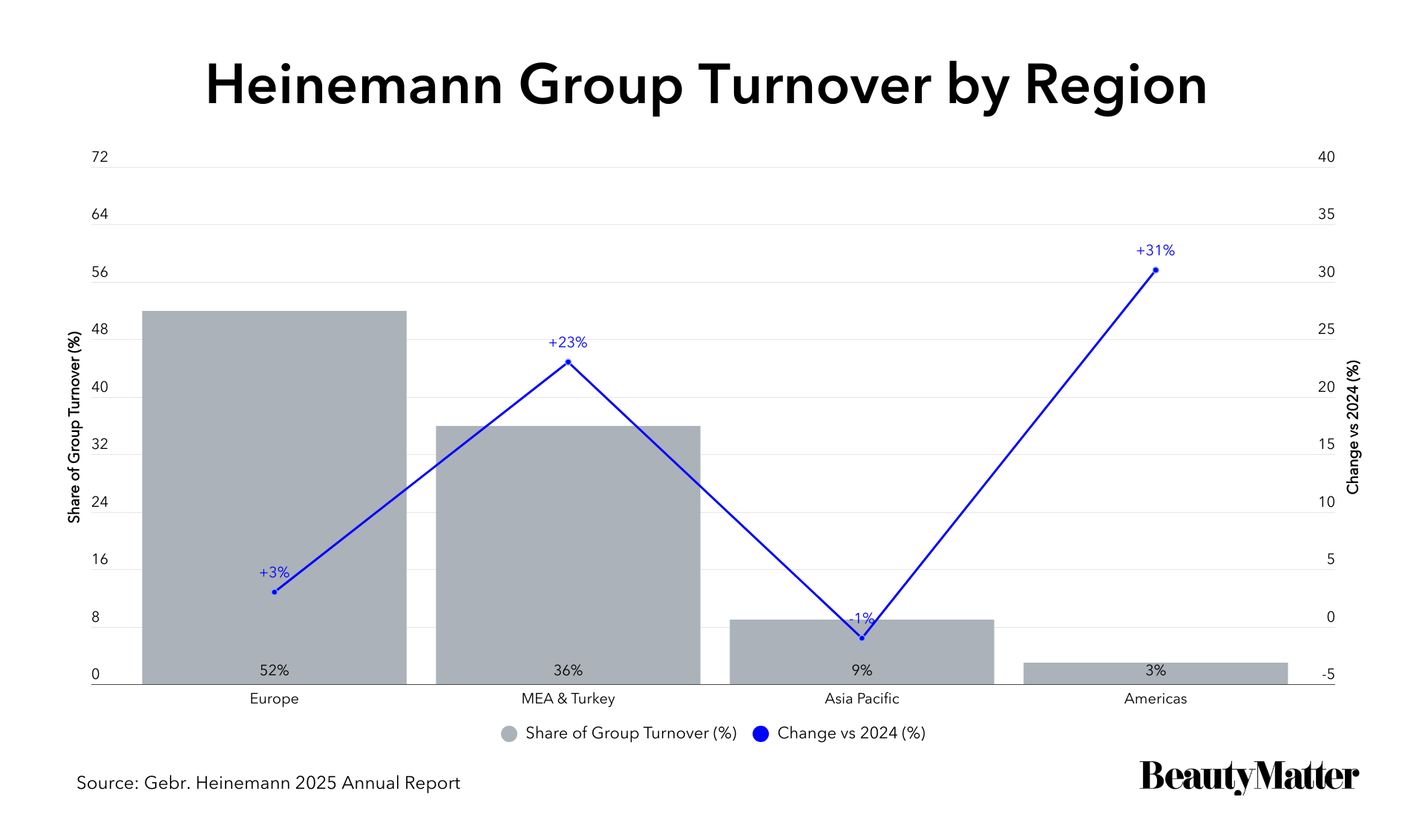
Fluctuating demand patterns last year did not prevent Heinemann from delivering broad-based growth across most regions (except Asia-Pacific, down 1%) and its key channels. Domestic distribution—a non-travel business unit and essentially representing the company’s share in fragrance distributor Nobilis, bought in 2023—climbed 18%, ironically showing the best growth. Heinemann Co-CEO Raoul Spanger said: “Nobilis has a clear target to become the leading beauty distributor in Europe in the next five years, and that is another leg for us to stand on.”
By region, the Middle East, North Africa and Turkey (MENAT) surged by 23% and now accounts for 36% of turnover, up from 33% in 2024, and is becoming more strategically relevant. Three of Heinemann’s top 5 airport retail locations are in this region: Istanbul (1), where a new logistics hub is being built, signaling its importance; Tel Aviv (2); and Antalya (4), also in Turkey. Meanwhile, Heinemann’s biggest market, Europe, grew by a more modest 3%, with its share dropping from 56% in 2024 to 52% last year.
Max Heinemann, owner and Co-CEO, said in a statement, “Volatility has become our baseline; planning cycles are repeatedly interrupted, and too often we are switching back into crisis mode instead of tackling the structural changes reshaping our industry. That is why it is crucial that we not only react to each disruption but also prepare for the traveler of tomorrow."
Part of that preparation is a full-scale dissection of what is encouraging consumers to purchase, and what isn’t. Beauty, niche fragrances, and premiumization trends played a central role in driving demand last year. Beauty—the company’s most strategically important category—accounted for 41% of revenue in 2025, growing by 7%. Strong sales of entry-priced and high-end scents—a major driver of premiumization in travel retail—were offset by the middle ground languishing, and skincare and color also underachieving.
About 16% of Heinemann’s beauty revenue globally now comes from entry-priced products, according to Chief Commercial Officer Inken Callsen, who cited “the paradox of choice” as a core factor inhibiting growth across mid-priced lines. The phrase stems from the 2004 book The Paradox of Choice: Why More Is Less by Barry Schwartz, which notes that when consumers have more options, they often buy less. Spanger said, “More and more brands do not lead to more turnover. The offer has to be clear and focused, and that’s what we’re working on—the next generation of shops.”
Though beauty’s 7% growth was in line with that of the airport channel, where 72% of Heinemann’s sales are made, it and other big categories, such as wine and spirits, performed below the 10% company average. This has led the retailer to develop a new data-driven “assortment engine” to sift through sub-channels down to the SKU level and drop non-performing lines (by 10% of the catalog last year), and elevate segments that are popular.
Callsen said, “Beauty is a dynamic category, but it’s tricky, as it’s not delivering the growth seen in the past. Fragrances are doing well, helped by niche and luxury sub-categories, as well as base-price products, but other segments are underperforming. A challenge is the wide range that we have. Social media–driven newcomers make a difference, but core brands may not be giving consumers what they want.”
Callsen told BeautyMatter that in locations where luxury niche beauty had been given its own dedicated areas, it was selling very well. In the Vienna Airport, for example, niche now accounts for 10% of fragrance sales “at least, and possibly even 20%.” She added, “At Istanbul [airport], it’s huge.” Niche and artisanal fragrance brands will continue to outperform if they are supported by exclusive concepts, storytelling-led merchandising, and a shift towards more personalized scent profiles. At the same time, travel retail sets, special offers, and base-price propositions demonstrate that value and luxury can coexist within the same category architecture.
Nobilis, as noted, delivered strong growth, especially in the domestic markets of Germany, Austria, Switzerland, and Scandinavia. The purchasing trends, however, were the same. “The luxury brands and the entry-priced products are seeing growth,” said Callsen. “Domestically, the biggest challenge is the market for dupes, where you can find a €10 copy of a niche fragrance. In travel retail, we will never integrate these products, because we are a brand-building platform.”
Heinemann is examining its assortments and pricing for every airport, right down to the terminals, so that each location’s product offer is more relevant. The brains behind the “assortment engine” is Director of Commercial Effectiveness Oliver Kreft, who is leading a new team of in-house data scientists and engineers in examining the SKUs in all categories to sharpen selection and pricing. This is designed to strengthen consumer appeal as Heinemann prepares for the next phase of its long-term expansion.
“Our ambition is to focus on curated assortments, strong brands, travel retail exclusives, and clear value propositions, all supported by data-driven pricing and close collaboration with our partners,” said Callsen. “Turning data and insights into impact creates more relevant offers.”

Kreft commented that of all the 215,000 SKUs Heinemann stocks, 30% are loss-making and more than 50% are cannibalizing others in-store. This has encouraged the company to move radically by transforming its assortment management at scale through data interrogation to identify sweet spots at individual shops, whether in beauty or spirits.
Importantly, while rationalization is taking place, Kreft said the retail offer would allow for some novel/interesting loss-making lines “because we want varied and exciting assortments that might inspire shoppers.” The project, piloted in the Vienna Airport—where the data has suggested a disruptive skincare cull of 20%—is now rolling out across larger Heinemann locations, with Frankfurt (where the company has a large new store in the just-inaugurated Terminal 3) slated for May 2026.
Kreft told BeautyMatter: “This is a starting point to being more data-driven, clearer, and faster. As soon as we’ve tackled assortments, we will move on to a promotions engine. Then, with pricing as well, we will have all the levers in place.” He added, “The era of easy wins is over, and the era of smarter value creation has begun. Technology is giving us transparency and analytical power we never had before. What will win is orchestration and curation, instead of overload.”
Zooming out to the group level, Heinemann does not publicly state its profits, but Spanger said 2025’s were “satisfactory.” In a statement, Max Heinemann added, “Profitability and discipline are essential for maintaining our entrepreneurial freedom. They enable us to think beyond short-term cycles and invest in people, in partnerships, and in infrastructure.”
For the rest of 2026, he said it would continue to expand in “high-potential markets” and bring its new assortment and pricing strategies up to full speed while collaborating with suppliers. The Co-CEO added, “The industry is changing structurally, [and] success will depend on relevance for travelers, resilient business models, and partnerships built on trust. We are confident that our long-term mindset and diversified set-up will position us well.”