





Key Takeaways:
When conversations about inclusivity in beauty intensified in 2020, the industry’s reflex response was often visible. It included broader shade ranges, diverse campaigns, and public pledges. Far less attention was paid to what happens long before a product ever reaches a shelf; that is, inside the lab, where formulas are tested, approved, and deemed “effective.”
For cosmetic chemist and clinical researcher AJ Addae, that blind spot was impossible to ignore. “I didn’t get into beauty because I’m a beauty fanatic,” Addae said to BeautyMatter. “I actually got into beauty through science.”
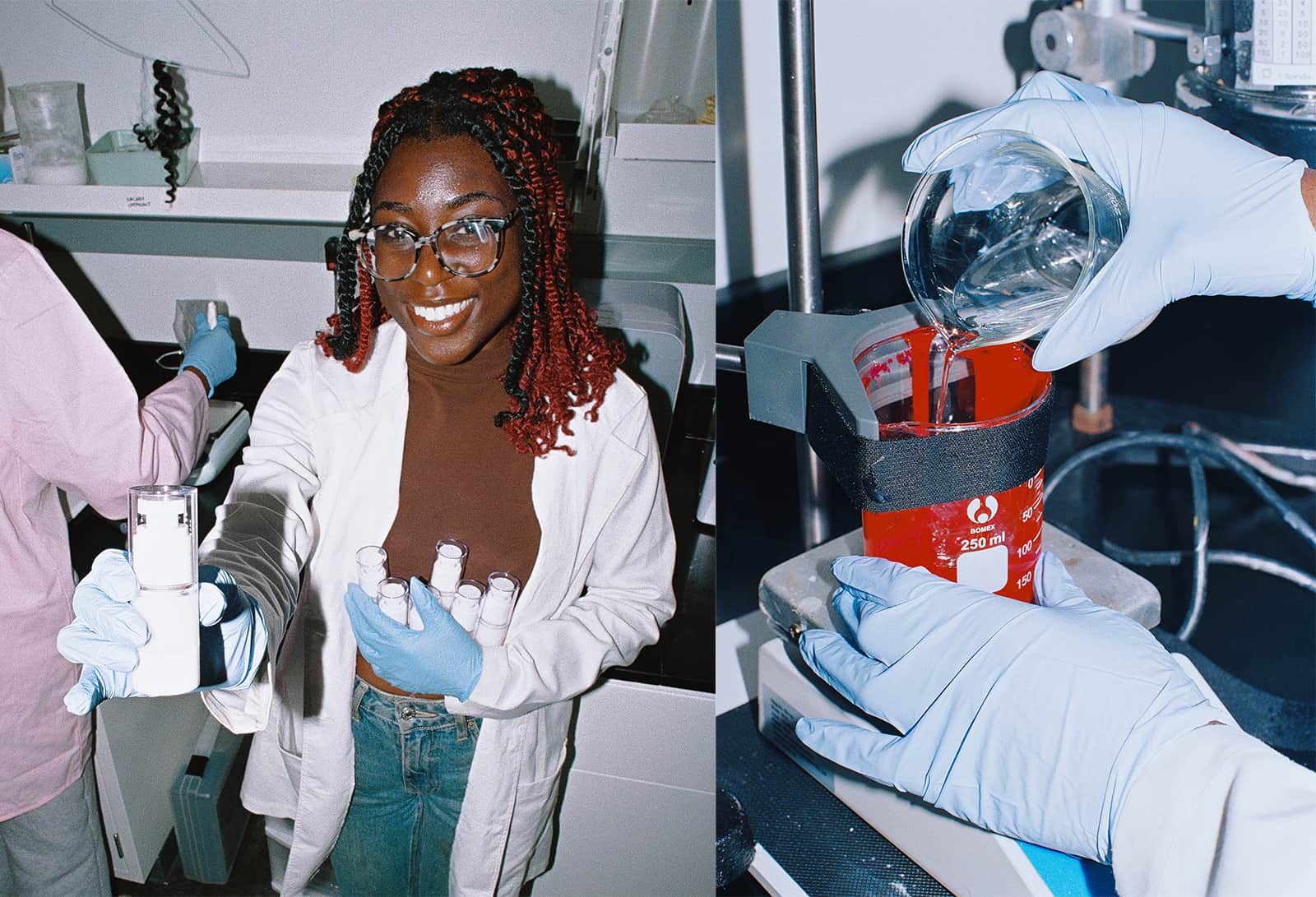
Addae is the founder of Sula Labs, a research and development laboratory dedicated to formulating and testing beauty products for melanin-rich skin tones and textured hair, a demographic that has historically been underserved, and often excluded, at the R&D stage. Founded in 2021, Sula Labs operates at the intersection of cosmetic science, clinical research, and business innovation, positioning inclusivity not as a marketing value, but as a technical imperative.
A Scientist’s Path to Beauty
Addae’s background spans cosmetic science, clinical research, and medical-grade skincare. Before founding Sula Labs, the PhD candidate worked at manufacturers and alongside cosmetic science teams, gaining firsthand exposure to how products are evaluated, and who gets left out in the process.
“Formulas can be approved without people that look [melanated] in the lab testing them,” she explained. “There are so many ingredients out there that have been in so many formulations that may not be tested specifically for efficacy on us.” Those omissions are not abstract. They show up visibly in categories like hyperpigmentation treatments, sunscreen white cast, and makeup shade ranges. These are all areas where melanin-rich consumers routinely report poorer outcomes.
Addae saw the issue most clearly while formulating sunscreens. “People would put on the sunscreens, it looks great, like the formula’s done,” she recalled. “And I would be like, ‘No, there’s still more work to do.’” That insistence on going further would eventually become the foundation of Sula Labs.
In 2021, Addae came across a call for research proposals seeking projects that bridged STEM and social justice. The grant offered just $5,000, a modest offering by industry standards, although transformative for her. “What I did was I begged a nearby research university,” she said, laughing, “to let me do a proof-of-concept study.”
That study produced a crucial finding: it takes longer to alleviate hyperpigmentation on darker skin tones when it is treated with the same ingredients used for lighter skin. For Addae, the data validated what many consumers already knew anecdotally, and reframed it as a solvable scientific problem. “This isn’t just something I’m imagining,” she said. “This is a problem that should be solved.”
The grant funding allowed Addae to secure a tiny lab space in Los Angeles and basic equipment. Sula Labs was born—“accidentally,” she noted, but with a clear purpose.
Filling the R&D Inclusivity Gap
From the outset, the lab didn’t struggle to find demand. “This problem has long existed,” said Addae. “The problem of there being what we call inclusivity gaps in beauty [exist because of] much of the R&D that took place behind the product.”
In an industry optimized for speed, especially through private-label models and compressed development cycles, specialization often falls by the wayside. The faster brands move, Addae argued, the more likely certain consumers are to be excluded from efficacy altogether.
Sula Labs’ early customer base grew rapidly, expanding from one brand to 10 within a short period. However, a pivotal moment came in early 2022, when Addae publicly explained the science behind The Honey Pot Co.’s reformulations via social media. “I did some social media posting through the Sula Labs account kind of explaining why these things were necessary,” she said. “Why there should be trust, etc.”
Trust, Addae emphasized, is critical for melanin-rich and textured-hair consumers who have historically been excluded, and sometimes harmed, by beauty R&D. She pointed to examples like tretinoin’s clinical legacy and the limitations of the Fitzpatrick Scale as evidence of systemic gaps in research design. The response to her commentary led to an invitation from The Honey Pot to create educational content, followed by an appearance as a chemist on a panel at Essence Festival, a visibility milestone that accelerated Sula Labs’ growth.
Beyond Formulation: Why Testing Matters
Today, Sula Labs works with brands including Loved01 by John Legend and Pattern by Tracee Ellis Ross, offering formulation alongside clinical and consumer testing, a key differentiator in its model. “You can only formulate so much to address certain needs,” Addae said. “But it’s really the testing to show the efficacy of the products on a range of skin tones and skin types.”
That emphasis reflects Addae’s broader philosophy: inclusivity drives efficacy. “Most of the people in the world have melanin-rich skin and textured hair,” she noted. “Once brands catch on to that, they really resonate with the mission.” Her credibility is reinforced by constant engagement with the scientific community. She has presented research at Beauty Accelerate, the Society of Cosmetic Chemists, and MakeUp in LosAngeles, among others. “My entire PhD is on sunscreens and white cast and improving them,” she said. “I’m a full-time researcher on this problem.”
Notably, Sula Labs does not manufacture products. Instead, it focuses on R&D, and then tech-transfers formulations to vetted manufacturing partners. “We are responsible for all of the research and development, all the testing and all the formulation that goes behind a product,” Addae explained. “Then we tech-transfer the formulations to manufacturers that are partners within our network.”
This approach allows Sula Labs to avoid competing with manufacturers and instead collaborate with them. Its network includes partners capable of supporting both low minimum order quantities for early-stage founders and large-scale production for retail-ready brands. “Different manufacturers have different personalities,” Addae explained. “A manufacturer that’s turning 500,000 units a year may not have time to focus on the new brand that wants to solve a specific issue for our community.”
Manufacturers in Sula Labs’ network are based across the US, including the East Coast, West Coast, Dallas, and central regions, offering brands flexibility and scalability.
While Sula Labs’ clients are primarily US based, Addae is looking ahead, particularly toward Africa. “I’m Ghanaian,” she explained, noting the deep influence African beauty has had on her work. African-sourced ingredients like shea butter and baobab oil are sourced, where possible, from women-owned cooperatives, ensuring the supply chain reflects the same values as the lab. “That homage is paid back to our roots,” she said.
As Sula Labs enters its fifth year, Addae acknowledged that scaling talent remains a challenge, particularly finding scientists who align with the lab’s philosophy of inclusivity and efficacy. Still, she remains optimistic as more young women of color enter cosmetic science.
“If you don’t love the problem, you can’t do this,” she said. “I’m obsessed with this problem. I am fully committed to it.” Copycats, she added, won’t last. “They can’t do it if they don’t love the work.” For Sula Labs, that commitment, grounded in data, science, and long-term vision, is what sets it apart in an industry still learning that inclusivity begins long before the campaign brief.