Key Takeaways:
It seems urban ice baths and sauna venues are becoming the new nightclubs—spaces where self-care meets community in ways that are slowly reshaping how we socialize. Driven by millennials' thirst for the wellness market, which is projected to reach $9 trillion by 2028 according to the Global Wellness Institute (GWI), concepts like Othership are enjoying continuous demand, proving the product-market fit is present and the opportunity sizable. This movement has attracted investors from the tech and health sectors who recognized a behavioral shift with staying power, funding pioneers such as Othership or Remedy Place in the US. As demand continues to grow, new entrants are emerging, slowly hinting that such venues might soon turn from niche to mainstream.
The Business of Social Wellness
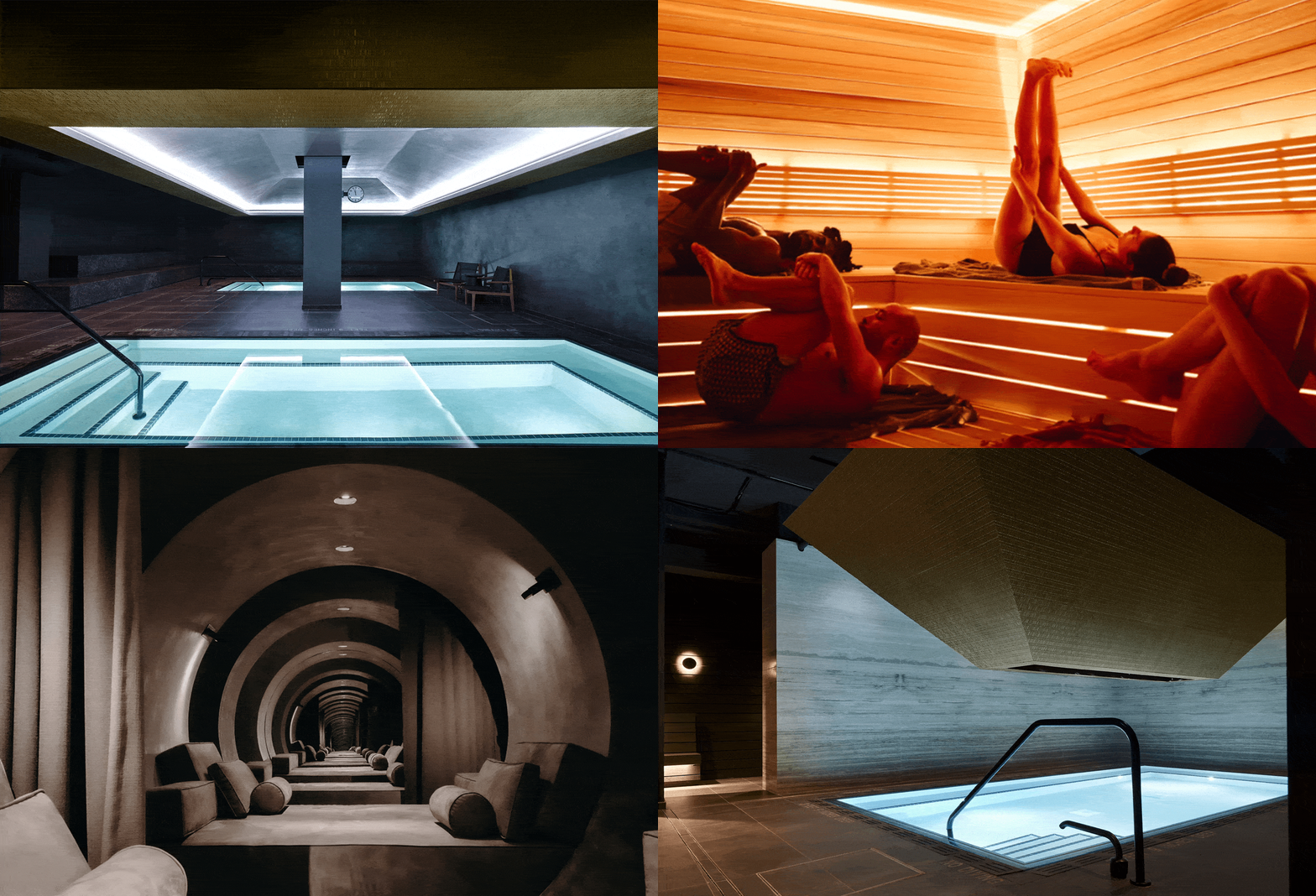
Urban bathhouses aren't new; city sanctuaries, inspired by ancient traditions from Finland, Norway, and Turkey and designed for relaxation and self-care, have existed for years. New York welcomed AIRE Ancient Baths back in 2012, while Los Angeles is home to popular Wi Spa, operating for over a decade. What distinguishes this new wave is their studio-like design: structured classes, community events, and social lounges are integral to the experience, rather than afterthoughts.
Valerie Thomas, a wellness business strategist and consultant who helps developers and hotels design wellness experiences, explains: “Millennials and Gen X are seeking spaces that blend community, emotional regulation, and state change into one experience, a shift that social wellness clubs are uniquely positioned to meet.”
The numbers tell a compelling story. Based on a GWI report, wellness real estate is among the fastest-growing segments of the booming wellness market and will reach nearly $1 trillion by 2029. In addition, GWI’s research also states that thermal and mineral springs alone represent a $70+ billion market with more than 30,000 facilities worldwide, indicating serious demand and market viability.
The emergence of the modern bathhouse concept rests on two truths: hot and cold therapies deliver proven health benefits for body and mind, and people are increasingly stressed and lonely, craving in-real-life social experiences. This intersection of health and social connection forms the core value proposition behind concepts like Othership, Remedy Place, and Bathhouse in the US, with New York City leading the charge. The primary focus is contrast therapy—alternating between hot saunas and ice baths, with certain venues also offering treatments, including functional medicine or IV therapy. This concept immediately stuck with investors.
Othership raised an $11 million Series B this summer to expand its modern bathhouse concept across the US, counting a variety of health-focused and consumer wellness VC funds as investors, such as Rocana Ventures, 5D World, and Arben Ventures.
Vine Ventures founder expressed his belief in the business model and overall concept, when he released a statement after first backing up the business for its Series A in 2022: “The initial facility in Toronto has completely blown away even our most optimistic expectations for number of users per week, EBITDA, and overall performance. We know the model works, we know Othership has product-market fit, and we know other cities around North America will passionately embrace this offering. Now is the time to scale.”
Remedy Place followed a similar trajectory, raising $5 million in 2022 at a $60 million valuation, backed by celebrity investors including DJ Zedd, NFL player Marcedes Lewis, and the band Rüfüs Du Sol. Founded by Jonathan Leary, a doctor with a degree in chiropractic and alternative medicine, Remedy Place reimagines holistic care by placing social connection at its heart. The mission: help individuals feel better and more connected—to their bodies, minds, and each other.
The first location opened in LA before expanding to NYC, offering a blend of “remedies” including breathwork, ice bath classes, oxygen chambers, massages, red light therapy, acupuncture, and IV drips.
Both companies are targeting saturated metropolitan markets such as Flatiron, SoHo, and West Hollywood, aiming to reach every major US city. Remedy Place currently operates three locations with a Boston opening imminent, while Othership launched in Canada with two locations before establishing a 7,000-square-foot Flatiron sanctuary and a recent Williamsburg outpost.
Their core demographic is urbanites aged 28-45 looking to optimize their health while staying social. Recently, it seems the NYC-based locations have attracted the likes of “bankers and tech bros,” as mentioned by a local publicist. At the same time, she said, Othership is also filled with women looking to indulge in self-care while being immersed in a relaxing and sleek atmosphere. Demand continues to surge: Othership's Flatiron location welcomes up to 500 people daily, tapping into a city where stress, loneliness, and social hunger converge.
Other players are seeing the light of day, with The Altar opening soon in Flatiron with a vision of “health as a cultural gathering place.” The trend is spreading internationally—The Arc offers community-driven contrast therapy in London, while Paris will welcome its first social wellness sanctuary in early 2026.
Founded by Jules Bouscatel, the Parisian concept, called Sant Roch, came as a realization to him when analyzing market dynamics. “First came high-impact workouts, followed by low-impact studios, and there’s now a third phase moving beyond fitness, toward recuperation and longevity.” His target audience includes three types of profiles: athletes, biohackers (individuals obsessed with optimizing biomarkers), and self-care enthusiasts alike. The space will feature ice baths and saunas designed to promote both self-care and social interaction, complemented by a tea room and a lounge area.
Turning Ancient Rituals into Modern Self-Care
Unlike traditional spas, venues like Othership or Sant Roch are designed to be shared, not isolating. These modern venues are all focused on placing community and socialization at the center, much like the original cultural roots of these practices. Turkish hammams and Finnish saunas have always served as places of cultural gathering, while in Scandinavian countries, saunas remain an ordinary part of daily life, meant to be enjoyed as a group.
The timing of this modern revival isn’t a coincidence: Othership and Remedy Place raised capital right after the pandemic, with other venues joining in this year. In a context of forced isolation, followed by economic uncertainty and persistent stress, wellness as a shared experience fills a void.
Bouscatel explains how these rituals are naturally compatible with social engagement: cold plunges boost adrenaline, while saunas decrease the stress hormone cortisol, fostering relaxation—a pairing set to create the perfect mindset and energy to socialize with fellow visitors. “The premise of our offering is that people are open-minded and join specifically to interact and build connections.”
This social focus shines through Othership as well. Katelyn Powers, Brand & Product Designer for Othership, specializes in wellness retail and hospitality. Her experience working with Othership reflects wellness's evolution from isolated luxury to inclusive gathering.
“The new wave of wellness feels more open, expressive, and collective,” she told BeautyMatter. “The older model was about retreat and luxury—stepping away from life to recharge. However, before that, we had community bathing and sacred rituals that brought humans together daily. What’s emerging now is more in that vein, is about integration.”
As the creative mind behind Othership’s merchandising, Powers focuses on amplifying the emotions felt at the venue and extending that sense of peace home, through candles, incense, or functional body fragrances.
“I’m always trying to create a sense of warmth and aliveness,” she said. “These days, the industry we are referring to as ‘wellness’ can sometimes feel overly curated, but I’m more drawn to what feels honest and soulful. The values I circle back to are connection, care, and curiosity—how well-designed products can make someone feel both grounded and inspired.”
Othership sells a selection of “rituals”: incense, essential oils, wooden gua shas, and herbal teas, all developed to offer guests the opportunity to extend the experience at home. With the essential oils market poised to grow at a CAGR of 10% between 2025-2030, according to Grand View Research, and the home fragrance market in continuous boom since the pandemic, creating products and scents meant to unlock soothing benefits and offer a moment of self-care at home is definitely a relevant play. But merchandising is just one diversification avenue.
Social Sobering as the Natural Evolution of These Concepts
Social bathhouses are evolving in both services and spaces. No longer limited to classes, they are extending their proposition to any occasion where social gathering and health converge. Othership has developed a guided breathwork app, singles socials and founders’ nights, while Remedy Place now offers B2B services for corporate year-end parties and events, providing alternatives to traditional alcohol-centered gatherings.
The idea is refreshingly innovative: instead of team gatherings revolving around alcohol and partying, these players offer colleagues the chance to wind down in an immersive, calming environment where they can socialize and restore themselves.
Remedy Place’s newly expanded events website page promotes personalized corporate retreats, team outings, and client events built around self-care: “We design experiences that reduce stress, build real connection, and return people to work with more energy and clarity,” it reads. Goldman Sachs, Nike, HBO, BMW, and American Express are just a few of the corporate clients that have tested new ways of socializing with colleagues and clients.
Beyond catering to new audiences with tailored services, these self-care venues increasingly position themselves as social clubs. Othership's DJ-powered sauna parties have proven wildly popular, suggesting these concepts may genuinely reshape culture and social interactions, with self-care at the epicenter.
Bouscatel echoed this vision: “I want to create a welcoming space where socialization can happen with no alcohol present. People will naturally feel relaxed and invigorated, so it sets the stage for healthy, enjoyable ways to interact.” Thomas also considers these new types of wellness venues are healthy third places, not just because they promote longevity and self-care, but because they position themselves as alternatives to social gatherings centered around alcohol. “They represent a modern alternative to bars or nightlife—particularly appealing to millennials and Gen X seeking connection without intoxication,” she says.
Gallup Analytics reported that only 54% of Americans affirm drinking alcohol frequently, the lowest percentage in their 90 year-trend research. Moreover, 60% of Gen Z and millennials prefer to enjoy alcohol-free night outs; it is not surprising that these concepts speak to many. Overall, they offer a compelling value proposition where health meets socialization and self-care, in conveniently located urban centers, providing perfect escapism and moments of peace.
Will such modern bathhouse concepts become a pillar of urban wellness? Thomas certainly thinks so: “These venues offer belonging, routine, and identity—a place to return to multiple times a week, not an occasional escape. They are full operating models, built intentionally with programming, guest flow, and revenue structure at the center.”